


350-101 Free Certification Exam Material from Prep4away with 127 Questions
Use Real 350-101 - 100% Cover Real Exam Questions
NEW QUESTION # 43
What happens when a radio wave bends around objects?
- A. absorption
- B. diffusion
- C. reflection
- D. diffraction
Answer: D
Explanation:
When a radio wavebends around an obstaclein its path, this phenomenon is calleddiffraction. Diffraction allows the RF signal to reach areas that are not in the direct line of sight of the transmitter, such as behind walls, corners, or other obstructions. The amount of bending depends on the wavelength of the signal relative to the size of the obstacle-longer wavelengths (lower frequencies) diffract more effectively than shorter wavelengths.
This property is crucial in wireless network design, especially in enterprise or mesh deployments, because it enables coverage in complex indoor environments and around obstructions where direct line-of-sight communication is impossible. Diffraction differs from other RF phenomena:absorption(option A) occurs when RF energy is partially absorbed by materials, reducing signal strength;diffusion(option B) refers to scattering of the signal in multiple directions; andreflection(option C) occurs when RF waves bounce off surfaces like walls or ceilings, which can lead to multipath interference.
Cisco wireless design guides emphasize understanding diffraction forcoverage planning, AP placement, and optimizing signal propagationin indoor and campus deployments, ensuring that signals can adequately reach shadowed or obstructed areas without excessive loss or dead spots. Reference topic:RF Fundamentals - diffraction, reflection, absorption, and indoor wireless propagation.
NEW QUESTION # 44
Refer to the exhibit.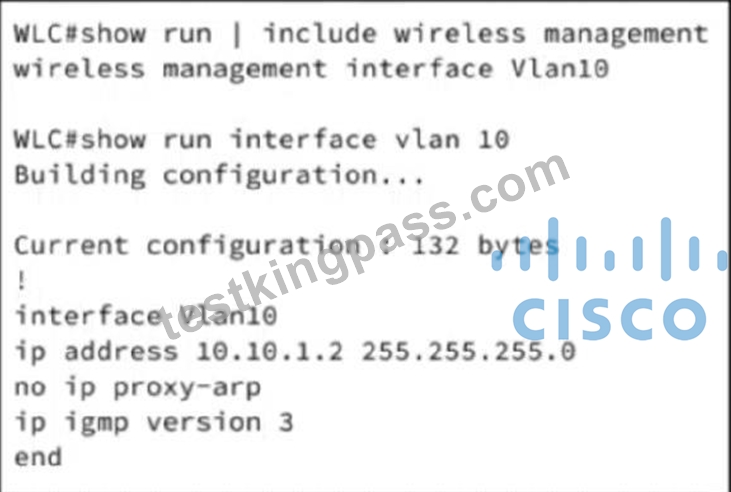
An engineer is setting up a new WLC in a branch office. The IT security policy states that all management access must use encrypted protocols, administrators will connect remotely, and network scans will be run to check for any noncompliant management protocol exposure. Which action must the engineer take to achieve the required management access policy?
- A. Enable Telnet, SSH, and HTTPS across the management and guest interfaces.
- B. Permit console access for 10.10.1.0/24 only with HTTP disabled.
- C. Permit only HTTP, Telnet, and SSH across all VLANs for 10.10.1.0/24.
- D. Enable HTTPS and SSH, and disable HTTP and Telnet on the WLC.
Answer: D
Explanation:
The correct action is to expose only encrypted management services: HTTPS for WebUI administration and SSH for remote CLI administration. The exhibit confirms the WLC wireless management interface is VLAN
10 with IP address 10.10.1.2, but interface placement alone does not enforce secure management protocol policy. Cisco Catalyst 9800 documentation identifies web admin settings as controller management configuration that determines administrator access, protocols, and interfaces for remote management. Cisco further states that administrators can connect securely over HTTPS, while HTTP "is not a secure connection," and that HTTPS encrypts data to and from the server.
For CLI access, Cisco's Catalyst 9800 Secure Shell guidance states that SSH enables secure remote access, and usingtransport input sshprevents non-SSH Telnet connections, limiting the device to SSH-only access.
Therefore, options A and B violate policy because they permit Telnet and/or HTTP. Option C fails because console access is local, not remote, and disabling only HTTP still leaves Telnet exposure unresolved.
Reference topics:Wireless Monitoring and Management - WLC management access, secure administration, HTTPS, SSH, and management-plane hardening.
NEW QUESTION # 45
Which new attribute does IEEE 802.11ax introduce when used in wireless local area networks?
- A. OFDMA
- B. Wi-Fi multimedia
- C. 60 GHz utilization
- D. MIMO
Answer: A
Explanation:
IEEE 802.11ax, also known as Wi-Fi 6, introduces several advancements to improve network performance, particularly in dense environments. Among these,OFDMA (Orthogonal Frequency Division Multiple Access) is a key feature introduced by 802.11ax. OFDMA allows more efficient use of the available spectrum by enabling multiple users to share the same channel simultaneously. This is done by subdividing the channel into smaller sub-channels, allowing data to be transmitted to multiple devices at the same time, improving overall throughput and reducing latency.
Option A: 60 GHz utilizationrefers to Wi-Fi standards like 802.11ad and 802.11ay, which use the 60 GHz band, but 802.11ax focuses on improving efficiency in the 2.4 GHz and 5 GHz bands, not the 60 GHz band.
Option B: Wi-Fi multimediais related to Wi-Fi features that prioritize multimedia traffic, but it is not a new attribute specifically introduced by 802.11ax.
Option D: MIMO (Multiple Input, Multiple Output)is a technology that allows multiple antennas to be used at both the transmitter and receiver, and while MIMO is supported in 802.11ac, it was enhanced in 802.11ax withMU-MIMO (Multi-User MIMO)for uplink, not a new technology introduced by 802.11ax.
Therefore,OFDMA(Option C) is the correct answer, as it is a key feature that 802.11ax introduces to improve network efficiency and capacity.
NEW QUESTION # 46
What is the purpose of YANG when used with the NETCONF protocol in the context of Cisco wireless controllers?
- A. Proprietary Cisco scripting language used exclusively for automating wireless controller configurations
- B. Human-readable data modeling language used to define device configuration and operational data
- C. Security protocol that encrypts configuration data during transmission between network management systems and devices.
- D. Protocol that directly transports configuration data between network devices without requiring any data modeling
Answer: B
Explanation:
YANG (Yet Another Next Generation) is a data modeling language primarily used in conjunction with the NETCONF (Network Configuration Protocol) to model configuration and operational data for network devices, including Cisco wireless controllers. YANG is a human-readable, hierarchical language designed to define the structure of data, allowing for consistent representation of configuration parameters, operational state, and notifications. It is extensively used in network automation and management systems to ensure standardized configuration management across various devices, making it easier for network administrators to automate and configure network devices using NETCONF.
NETCONF is the protocol that facilitates the transport of these data models (defined in YANG) between network devices and management systems. YANG's role is to define the structure and constraints of the data that NETCONF will configure or retrieve from devices. This allows administrators to configure network devices programmatically while adhering to a standardized data structure, which is essential for scalability, automation, and integration across various systems.
NEW QUESTION # 47
Refer to the exhibit. An onsite engineer is working to connect devices to the wireless network in a corporate environment. The network requirements dictate that WPA2-Enterprise security must be used with certificate-based mutual authentication to align with enterprise policy, which requires client and server certificates for secure access. After the initial wireless settings are applied on a Windows-based workstation, the engineer must select the appropriate authentication method in the client network properties to complete a successful enterprise Wi-Fi connection. Which option in the "Choose a network authentication method" dropdown meets this requirement?
- A. PEAP
- B. MSCHAPv2
- C. EAP-TLS
- D. TEAP
Answer: C
Explanation:
The correct authentication method is EAP-TLS. WPA2-Enterprise uses 802.1X/EAP authentication rather than a pre-shared key, and the supplicant, authenticator, and RADIUS authentication server participate in the enterprise authentication exchange. Cisco documentation states that in enterprise WPA/WPA2 operation, 802.1X/EAP is used for authentication and provides strong authentication between the client and authentication server.
The decisive requirement in the question is certificate-based mutual authentication requiring both client and server certificates. Cisco explicitly describes EAP-TLS as requiring both server-side and client-side certificates, while PEAP requires only a server-side certificate and normally authenticates the client with password-based credentials inside the protected tunnel. Cisco Secure ACS documentation also states that EAP-TLS uses the certificates of the authentication server and the end-user client, enforcing mutual authentication.
NEW QUESTION # 48
A network administrator at a marketing company manages a Cisco Catalyst 9800 Series Wireless Controller running Cisco IOS XE 17.x. The WLAN named XYZ-Guest is set up for visitors, and the administrator wants to implement a web authentication (WebAuth) portal using an external server to manage guest access. To ensure seamless and secure guest authentication, the controller must be configured to use an external WebAuth server for the WLAN. The administrator must configure the XYZ-Guest WLAN to use an external WebAuth server with a parameter map named webauth-ext. Which set of Cisco IOS XE commands must be used?
- A. wlan XYZ-Guest 2parameter external security-map webauth-ext
- B. wlan XYZ-Guest 2 XYZ-Guestsecurity web-auth parameter-map webauth-ext
- C. wireless wlan XYZ-Guestsecurity web-auth external webauth-ext
- D. wireless wlan XYZ-Guest 2 XYZ-Guestparameter-map webauth-ext
Answer: C
Explanation:
For configuring guest access on a Cisco Catalyst 9800 WLC using an external WebAuth server, the WLAN must be explicitly associated with the external server through a parameter map. The correct command syntax in Cisco IOS XE iswireless wlan < wlan-name > followed bysecurity web-auth external < parameter-map > .
This configuration links the WLAN to the external WebAuth server defined in the parameter map, allowing guests to be redirected to the portal for authentication. The parameter map (webauth-ext) contains details such as server IP, port, and other authentication parameters required for the external WebAuth interaction. Option B is incorrect because it improperly uses multiple WLAN names in one command, which is not valid syntax.
Option C usesparameter external security-map, which is invalid and does not associate the WLAN correctly with the WebAuth server. Option D incorrectly combines the security and parameter-map syntax and is not supported in IOS XE for external WebAuth. Cisco Wireless Core Technologies recommends this approach for centralized guest management, allowing consistent enforcement of guest policies, seamless authentication, and integration with external WebAuth servers across multiple WLANs and APs. Reference topics:Client Connectivity Configuration - WebAuth, external guest portal, WLAN parameter map configuration, Cisco IOS XE 17.x.
NEW QUESTION # 49
Refer to the exhibit.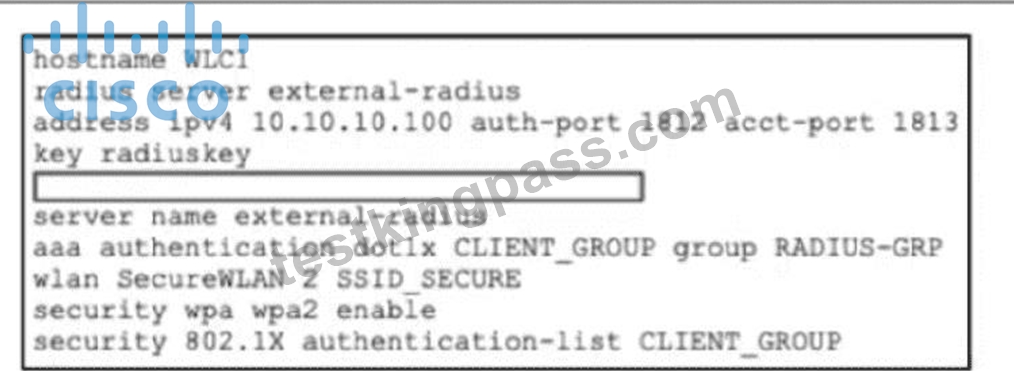
A network administrator is working on a WLC to enable user access for contractor desktops using WPA2- Enterprise using EAP-TTLS. The administrator verified the external authentication configuration and now must test network connectivity. Which code snippet must be added to the box in the code to complete the configuration on the WLC that supports authentication with an external server?
- A. aaa group server radius RADIUS-GRP
- B. aaa server group server radius RADIUS-GRP
- C. aaa group server aaa RADIUS-GRP
- D. aaa server group server radius RADIUS-GRP
Answer: A
Explanation:
The missing command must create the RADIUS server group context before the existingserver name external- radiuscommand can bind the defined RADIUS server into that group. Cisco's Catalyst 9800 802.1X configuration workflow shows the exact CLI sequence: define the RADIUS server, then enteraaa group server radius < radius-grp-name > , then addserver name < radius-server-name > . The Catalyst 9800 configuration guide likewise states that the RADIUS server-group identification is created withaaa group server radius server-group, followed by the server name assignment.
In this exhibit,external-radiusis already declared underradius server, andaaa authentication dot1x CLIENT_GROUP group RADIUS-GRPalready points the 802.1X method list to the server group namedRADIUS-GRP. Therefore, the box must containaaa group server radius RADIUS-GRPso thatserver name external-radiusis syntactically valid and functionally associates the external server with the group. Cisco also identifies dot1x authentication lists as the AAA method type used for 802.1X SSIDs, with "group" directing authentication to an external RADIUS server. Reference topics:Client Connectivity Configuration
- WPA2-Enterprise, 802.1X/EAP, AAA method lists, RADIUS server groups, and Catalyst 9800 WLAN security
NEW QUESTION # 50
What defines RSSI in radio signal measurements?
- A. Noise generated by interference
- B. QoS network packet marking method
- C. Detected amplitude level at radio receiver
- D. Wireless radio signal service ID
Answer: C
Explanation:
RSSI, or Received Signal Strength Indicator, is a measure of the detected power level of a radio signal at the receiver, expressed in dBm. It reflects the strength of the wireless signal received by the client or access point and is a critical metric for assessing coverage, link quality, and roaming decisions. Higher RSSI values (closer to 0 dBm) indicate stronger signals, while lower values (more negative) represent weaker signals. RSSI is used by Cisco wireless controllers and clients to make roaming decisions, select access points, and optimize transmit power levels. Option B, noise generated by interference, affects signal-to-noise ratio but does not define RSSI. Option C, QoS packet marking, pertains to network traffic prioritization, not RF measurements.
Option D, wireless radio service ID, refers to identifying services on a network and is unrelated to signal strength measurement. Understanding RSSI is fundamental in RF planning, AP placement, and troubleshooting wireless coverage issues. Cisco Wireless Core Technologies emphasize monitoring RSSI to maintain adequate signal levels across the deployment, ensuring seamless connectivity and performance in high-density or challenging RF environments. Reference topics:RF Fundamentals - RSSI, signal strength, link quality, roaming, RF planning.
NEW QUESTION # 51 
Refer to the exhibit. An engineer configured a static IP address on a LWAPP, but it is not reachable for management. The engineer configured the wrong gateway and must now change the default gateway to
172.16.100.1. Which CLI command must the engineer use?
- A. capwap ap ip default-gateway 172.16.100.1
- B. capwap ap controller ip address 172.16.100.1
- C. capwap ap ip 172.16.100.104 255.255.255.192 172.16.100.1
- D. capwap ap ip 172.16.100.104 255.255.255.0 172.16.100.1
Answer: D
Explanation:
When deploying a Lightweight Access Point (LWAPP) in a Cisco wireless network, proper Layer 3 configuration is essential for management and connectivity to the Wireless LAN Controller (WLC). Each LWAPP requires a valid IP address, subnet mask, and default gateway to communicate beyond its local subnet. In the exhibit, the AP is assigned 172.16.100.104/24, but the previously configured gateway was incorrect, preventing communication with the WLC. Cisco IOS XE requires that the AP's IP interface be configured with the correct default gateway to route traffic properly. The correct syntax iscapwap ap ip < AP- IP > < Subnet-Mask > < Default-Gateway > . Option D matches the IP, subnet mask, and gateway for the given network, ensuring the AP can reach the WLC for LWAPP registration. Option A only changes the gateway without setting the IP explicitly, which is insufficient if the IP needs adjustment. Option B incorrectly configures the controller's IP, which does not affect the AP's default gateway. Option C uses an incorrect subnet mask (255.255.255.192), which would place the AP in a different subnet, breaking connectivity. Proper default gateway configuration is critical to avoid registration failures and management issues. Reference topics:Client Connectivity Configuration - LWAPP AP IP configuration, default gateway, WLC communication, Layer 3 reachability.
NEW QUESTION # 52
A wireless engineer notices high retransmission rates on a WLAN supporting IoT devices operating at low data rates. Which configuration change is MOST appropriate?
- A. Disable lower data rates carefully
- B. Reduce RADIUS retransmissions
- C. Increase DTIM interval dramatically
- D. Enable MAC filtering
Answer: A
Explanation:
Disabling extremely low data rates improves airtime efficiency and reduces retransmissions caused by slow clients occupying the channel excessively. However, engineers must verify device compatibility before removing legacy rates. DTIM and RADIUS settings are unrelated to RF retransmission optimization.
NEW QUESTION # 53 
Refer to the exhibit. A client authenticates via 802.1X against an ISE server that is configured to return a specific VLAN ID (VLAN 100) via an attribute value pair. However, the administrator notices that the client is placed in the wrong VLAN (VLAN 50). What must the administrator implement to resolve the issue?
- A. Configure AAA VLAN enable on the WLAN.
- B. Configure the policy profile to allow ISE to override the VLAN.
- C. Configure VLAN 100 as an SVI on the WLC.
- D. Configure VLAN 100 on the trunk ports of the WLC.
Answer: B
Explanation:
In this scenario, the client is placed in the wrong VLAN (VLAN 50) even though the ISE server is configured to assign VLAN 100. The key part of the issue is that the VLAN assignment returned by ISE is not being applied correctly.
Option A: "Configure the policy profile to allow ISE to override the VLAN."This is the correct answer. The policy profile on the Wireless LAN Controller (WLC) should be configured to allow the ISE server's VLAN assignment to override the locally configured VLAN settings on the WLC. Without this, the WLC might default to its pre-configured VLAN (VLAN 50) instead of the VLAN assigned by ISE (VLAN 100).
Option B: "Configure VLAN 100 as an SVI on the WLC."This option is unnecessary. While an SVI (Switched Virtual Interface) is required to route between VLANs, it is not the cause of the issue here. The problem is that the correct VLAN (VLAN 100) is not being applied to the client, not that the WLC lacks an SVI.
Option C: "Configure VLAN 100 on the trunk ports of the WLC."This option is also not relevant. The issue is not with trunking but with VLAN assignment from ISE. The trunking configuration ensures that VLANs are allowed across ports, but it does not address the client being placed in the wrong VLAN.
Option D: "Configure AAA VLAN enable on the WLAN."This option is not directly related to the issue.
While enabling AAA VLAN can allow for more dynamic VLAN assignments, the core issue is related to overriding the default VLAN setting from ISE, which is handled by configuring the policy profile on the WLC.
Therefore,Option Ais the correct solution, as it ensures the WLC will allow the ISE server's VLAN assignment to override the default VLAN on the WLC, resolving the issue of incorrect VLAN assignment.
NEW QUESTION # 54
What is a characteristic of 20 MHz channel width in a wireless network?
- A. Higher throughput than wider channels
- B. Supports automatic client reassociation
- C. Increases authentication handoff frequency
- D. Narrowest channel width in the 2.4 GHz band
Answer: D
Explanation:
In wireless networks, the 20 MHz channel width is the standard and narrowest channel allocation in the 2.4 GHz frequency band. Using narrower channels reduces adjacent-channel interference and allows for better coexistence in high-density environments, which is particularly important in the crowded 2.4 GHz spectrum. A 20 MHz channel uses less RF bandwidth than 40 MHz or 80 MHz channels, providing more non-overlapping channels (channels 1, 6, and 11 in 2.4 GHz) to reduce co- channel interference.
NEW QUESTION # 55
Which hierarchy in a YANG data modeling approach describes a relationship in the context of NETCONF device configuration?
- A. child and parent structure
- B. tree and leaf-based structure
- C. object and attribute model
- D. hub and spoke model
Answer: B
Explanation:
YANG represents network configuration and operational state as a hierarchical data model. In Cisco model- driven programmability, YANG is used with NETCONF to model configuration and state data so that client applications can programmatically retrieve, edit, and manage device configuration. Cisco states that YANG is used with NETCONF for automated and programmable network operations, and that YANG primarily models the configuration and state data used by NETCONF operations.
The correct hierarchy is thetree and leaf-based structure. Cisco's YANG model structure description defines it as a hierarchical framework that organizes data into a tree with top-level nodes and nested child nodes, and groups related data through containers, lists, and leaves. In this model, containers and lists create structure, while leaf nodes hold actual values such as interface names, VLAN IDs, descriptions, IP addresses, or policy parameters. Option B describes a relationship inside the hierarchy, but it is not the full YANG modeling hierarchy. Options A and C are not valid YANG/NETCONF structural models. Reference topics:Automation and AI - model-driven programmability, NETCONF, YANG data models, configuration/state data, and Cisco IOS XE programmability.
NEW QUESTION # 56
Which function does FRA use to optimize client experience and network coverage?
- A. Implementation by local data path control
- B. Enhances roaming by redirecting the client to move to the appropriate AP
- C. Monitoring on the physical interface level in the AP
- D. Dynamically adapts the roles of dual-band radios in an AP
Answer: D
Explanation:
Flexible Radio Assignment dynamically changes the role of dual-band radios based on RF conditions, allowing the AP to improve coverage, capacity, and client experience by adapting radio operation to the wireless environment.
NEW QUESTION # 57
How does U-NII-1 operate with regards to the common frequency bands supported in enterprise wireless networks?
- A. It defines subsections with signal handling and is restricted to indoor use helping minimize interference.
- B. It defines class limits for specialty devices and is restricted to outdoor use increasing coverage.
- C. It uses a range of lower frequencies with restrictions on transmit power used indoor and outdoor.
- D. It uses a range of higher frequencies and tile enforcement with static power configuration.
Answer: A
Explanation:
U-NII-1 (Unlicensed National Information Infrastructure-1) is a segment of the 5 GHz band commonly used in enterprise wireless deployments. It is specifically designated for indoor use to help minimize interference with other devices and reduce regulatory conflicts. U-NII-1 operates in the lower 5 GHz range (5.150-5.250 GHz in the U.S.) and imposes power and indoor restrictions, which prevents outdoor deployment that could interfere with radar and other critical communications. This band supports 802.11a/n/ac/ax Wi-Fi clients, providing multiple non-overlapping channels that facilitate high-density enterprise deployments. By restricting usage to indoor environments, U-NII-1 helps maintain predictable coverage and mitigates interference from outdoor sources, making it ideal for office and campus environments where controlled radio propagation is critical. The access points and wireless controllers dynamically handle channel assignment and power levels to ensure efficient spectrum usage while conforming to these regulatory limitations. Option C accurately reflects these operational parameters by highlighting indoor restriction and interference minimization, whereas the other options mischaracterize the frequency range, power, or permitted use.
Reference topics:802.11 Technology Fundamentals - U-NII-1 band, indoor use restriction, interference mitigation, enterprise 5 GHz Wi-Fi deployment.
NEW QUESTION # 58
A wireless administrator must configure detailed and comprehensive monitoring for client devices across branch locations. The team wants to streamline operations for faster response during performance degradation. To support the organization's growth, the administrator needs a centralized reporting platform that displays aggregated data. Which solution must the administrator use to monitor the clients in the network?
- A. Implement central syslog server.
- B. Use Cisco Catalyst Center Assurance.
- C. Run show logging on WLC CLI.
- D. Use the WLC dashboard.
Answer: B
Explanation:
Cisco Catalyst Center Assurance is the correct solution because the requirement is centralized, scalable, multi- site client monitoring with aggregated health and troubleshooting data. Cisco states that Catalyst Center Assurance provides aClient health dashboardand supports both wired and wireless clients. It is specifically used to obtain a global view of all client device health and determine whether issues require action.
This directly matches the need for monitoring clients across branch locations and responding faster during performance degradation. Catalyst Center Assurance also provides location-based visibility, health scoring, client trend analysis, onboarding failure reasons such as AAA or DHCP, and Client 360 views for detailed troubleshooting. Cisco documents that Client 360 provides detailed client connectivity troubleshooting, including what problem occurred, when it occurred, why it occurred, and whether the impact is isolated or widespread. Cisco's Catalyst Center data sheet further describes Network and Client Health dashboards as giving administrators a high-level overview of every network device and client, with expansion by geographical site, device list, client list, or topology. Syslog, WLC CLI logging, and a local WLC dashboard are useful operational tools, but they do not provide enterprise-scale assurance analytics. Reference topics:
Wireless Monitoring and Management - Catalyst Center Assurance, Client Health, Client 360, centralized wireless monitoring, and operational analytics.
NEW QUESTION # 59
A wireless engineer is rolling out a group of new Meraki APs across multiple office floors. The APs must be centrally managed through the Meraki dashboard and be set up for automatic cloud registration. Network connectivity has been established, and the company firewall follows standard security policies. To minimize manual configuration for each AP the engineer must configure them to automatically discover the dashboard. Which action must the engineer take?
- A. Assign a static management IP to each AP using the local status page.
- B. Set up a site-to-site VPN between the switch on each floor and the data center.
- C. Register the AP serial numbers in the lease table of the DHCP server.
- D. Connect APs to a network with internet and allow outbound access to Meraki cloud.
Answer: D
Explanation:
Meraki AP onboarding is designed around cloud-initiated registration, not manual controller discovery. A Meraki AP must obtain network reachability, resolve Meraki cloud services, and establish outbound connectivity to the Meraki dashboard. Cisco Meraki documentation states that the dashboard provides centralized management and that, for dashboard management, a Meraki device must communicate with the Cisco Meraki cloud over a secure tunnel. The MR quick-start process further describes that, after power-on, the AP requests an IP address by DHCP, reaches the Meraki cloud through the Internet, and checks in to the dashboard.
Therefore, the required action is to connect the APs to a network with Internet access and permit the necessary outbound firewall flows to Meraki cloud services. A site-to-site VPN is unnecessary for dashboard discovery. Static management addressing may be used in constrained environments, but it increases manual work and is not required for automatic registration. DHCP lease-table serial registration is not a Meraki onboarding mechanism.
NEW QUESTION # 60
What is the maximum transmit power level allowed for 2.4 GHz in the United States?
- A. 23 dBm
- B. 36 dBm
- C. 30 dBm
- D. 20 dBm
Answer: C
Explanation:
The correct answer is 30 dBm, which equals 1 watt of conducted transmit power. In the United States, the 2.4-GHz ISM band used by 802.11b/g/n/ax Wi-Fi falls under FCC Part 15.247. The FCC rule permits digital modulation systems in the 2400?483.5 MHz band and specifies that the maximum conducted output power is 1 Watt. Converting watts to dBm uses the formula dBm = 10 log10(mW): 1 watt equals 1000 mW, and 10 log10(1000) = 30 dBm.
This is also consistent with Cisco wireless configuration behavior, where Cisco controller Radio Resource Management transmit-power limits use dBm values and support a configurable transmit-power range up to 30 dBm. The key distinction is that 30 dBm is conducted transmit power, while 36 dBm commonly represents an EIRP value when antenna gain is included, such as 30 dBm transmitter output plus 6 dBi antenna gain. Cisco RF fundamentals emphasize that antenna gain affects coverage and radiated energy, so transmit power and EIRP must not be confused.
NEW QUESTION # 61
......
Dumps Brief Outline Of The 350-101 Exam: https://passguide.testkingpass.com/350-101-testking-dumps.html