


[Aug 25, 2026] ACD201 Exam Brain Dumps - Study Notes and Theory
Pass Appian ACD201 Test Practice Test Questions Exam Dumps
Appian ACD201 Exam Syllabus Topics:
| Topic | Details |
|---|---|
| Topic 1 |
|
| Topic 2 |
|
| Topic 3 |
|
| Topic 4 |
|
NEW QUESTION # 38
You're making a POST request to the Appian web API. You need to include complex data structures, such as lists or objects, in the request body.
How should you design the API to accept those requests?
- A. Use XML format to represent the complex data structures in the request body.
- B. Use query parameters to represent the complex data structures.
- C. Convert the complex data structures to JSON and include them in the request body as a string.
Answer: C
Explanation:
To include complex data structures like lists or objects in a POST request to an Appian Web API, you should convert the data to JSON and include it in the request body as a string. Appian supports application/json content type for parsing complex data structures in APIs.
NEW QUESTION # 39
You're performing System Integration Testing on a client's application that integrates with an external system.
In this instance, you're testing the application's interactions with external integrations to ensure that data is being handled correctly between the two systems. However, this step has been done manually and is time- consuming.
What should you do to make this process more efficient?
- A. Utilize Appian-Locust to develop and execute performance tests on the systems integrations by scripting a scenario where multiple users are interacting with the external systems simultaneously.
- B. Utilize FitNesse for Appian to perform automated functional testing on the workflows that include integrated systems through a defined set of test cases.
- C. Utilize the Postman API Platform to test the integrations with the external system and Appian's web APIs through a defined set of test cases.
Answer: B
Explanation:
FitNesse for Appian is designed for automated functional testing of Appian workflows, including those that call external integrations. By building repeatable FitNesse test scripts that drive the end-to-end process, you can automatically verify that data is correctly sent to - and returned from - the external system each time, greatly reducing the manual effort of system-integration testing.
NEW QUESTION # 40
Your client wants their customers to be able to schedule appointments directly from their website without going to an Appian user environment.
You need to build an embedded interface to be added to your client's web page. The style of the embedded interface should be consistent with the host web page.
Which three custom styling options can be configured in the Themes section of embedded interfaces?
(Choose three.)
- A. Font Family
- B. Two or three column layout
- C. Web font stylesheet URL
- D. Asymmetrical layout
- E. Page background color
Answer: A,C,E
Explanation:
Page background color - You can customize the background color to match the host webpage's theme.
Font family - You can set the font family to ensure the embedded interface aligns with the client's branding.
Web font stylesheet URL - This allows the use of custom web fonts, further aligning the style with the host site.
NEW QUESTION # 41
You're maintaining a client's case management system.
The client needs you to review the performance of one of their interfaces as it is perceived to be quite slow The interface is a start form that users use to edit party records in the system. They can edit these party records either through the participant view of the case record or directly through the party record.
Given a party record may consist of many attributes, Custom Data Types (CDT) have been used for the purpose of writing to the database, while record types have been used to retrieve data.
What might be a potential cause for this issue, and what should you do?
- A. The user should only query and edit the attributes they are intending to edit. Hence, you should restrict editing through the case record and users should only edit the party through the party record
- B. The queries may no! be performant due to unexpected indexing conditions or be casting to the incorrect CDT. Hence, you should review the queries and adjust accordingly.
- C. CDTs are an inefficient method for writing to the database Hence, you should refactor the entire process to utilize records only
Answer: B
NEW QUESTION # 42
What are three locations to call an Integration that changes the source data? (Choose three.)
- A. Interface component savelnto parameter
- B. Process model (Call Integration Smart Service]
- C. Web API (GET)
- D. Rule
- E. Web API (POST, PUT, DELETE)
Answer: B,D,E
Explanation:
Integrations can be called from rules, allowing for source data changes when used in the proper context.
The Call Integration Smart Service in a process model can execute integrations that modify source data.
Web APIs using POST, PUT, or DELETE methods are typically used to change source data via integrations.
NEW QUESTION # 43
You need to create a read-only grid that displays support case information. Data for the support cases is mapped to the "Case" record type with data sync enabled.
Within the record, there are fields named "createdDateTime" and "resolvedDateTime". These two fields store the timestamps for when a case is created and resolved, respectively.
The grid includes a column indicating the number of hours between when the case was created and when it was resolved. This column must be sortable within the grid.
How should you calculate the hour value that will display in the column?
- A. Create a custom record field that evaluates in real-time, and calculates the number of hours between when the case was created and when it was resolved.
- B. Within the grid column, utilize an Appian function to calculate the number of hours between when the case was created and when it was resolved.
- C. Create a custom record field that evaluates at sync-time, and calculates the number of hours between when the case was created and the current date and time.
Answer: A
Explanation:
A custom record field that evaluates in real-time and calculates the hours between "createdDateTime" and
"resolvedDateTime" ensures the calculated value is available as a sortable field within the read-only grid.
NEW QUESTION # 44
You have a Case record type with data sync enabled to retrieve submitted support cases.
What is the best approach to limit who can see which records in the record type?
- A. Record-level security
- B. Default filters
- C. Security rules
Answer: A
Explanation:
Record-level security is the best approach for limiting which users can see specific records in a record type with data sync enabled, as it allows you to define access at the record level.
NEW QUESTION # 45
Your client wants their customers to be able to schedule appointments directly from their website without going to an Appian user environment.
You need to build an embedded interface to be added to your client's web page. The style of the embedded interface should be consistent with the host web page.
Which three custom styling options can be configured in the Themes section of embedded interfaces? (Choose three.)
- A. Font Family
- B. Two or three column layout
- C. Web font stylesheet URL
- D. Asymmetrical layout
- E. Page background color
Answer: A,C,E
Explanation:
Page background color - You can customize the background color to match the host webpage's theme.
Font family - You can set the font family to ensure the embedded interface aligns with the client's branding.
Web font stylesheet URL - This allows the use of custom web fonts, further aligning the style with the host site.
NEW QUESTION # 46
You're creating a process to update specific fields in a list of records and you save the updated records to the database.
You're given the following performance considerations:
Execution time
Process instance memory usage
Process execution engine load balancing
Based on these performance metrics, rank the options from best to worst.
Note: To answer, move all steps from the Options list to the Answer List area and arrange them in the correct ranking order (best at the top, and worst at the bottom).
Answer:
Explanation: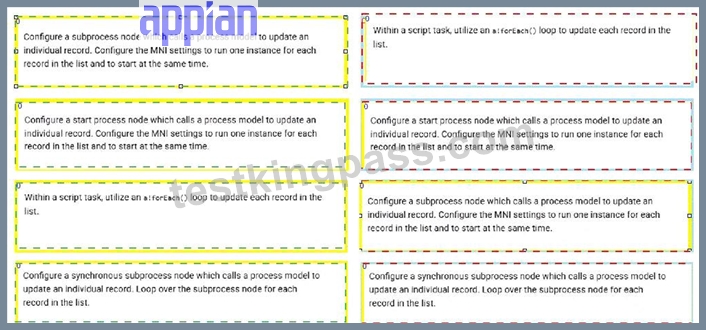
Explanation: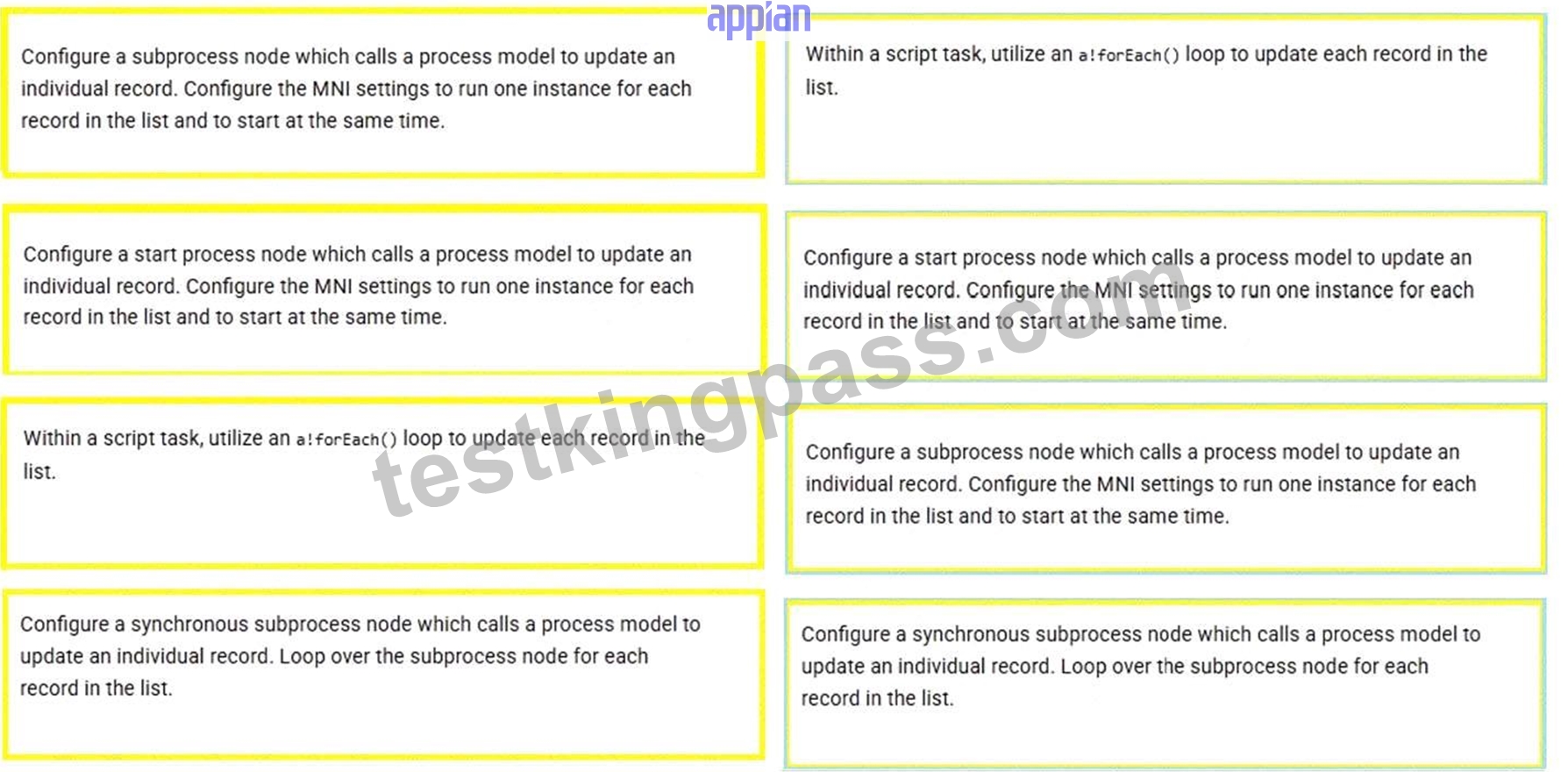
NEW QUESTION # 47
The synced record Task has a self-referential relationship defined in the column parentTaskId. There is a many-to-one record relationship between the id and parentTaskId called parentTask.
For a given task ID, you need to return the task name and the parent task name.
What should you do?
- A. Use a!queryRecordType() filtered on the task id once to return the task name and parent task ID. Query the record again to return the parent task name.
- B. Use a!queryRecordType() with a filter on the task id, with fields specified to return recordType!Task.name and recordType!Task.parentTask.name.
- C. Create a sync-time custom record field on the Task record called parentName. Specify this field to return in the query field selection.
Answer: B
Explanation:
Using a!queryRecordType() with a filter on the task ID and specifying both recordType!Task.name and recordType!Task.parentTask.name in the fields will efficiently return both the task name and its parent task name in a single query.
NEW QUESTION # 48
You need to select a plug-in to meet a specific requirement and several plug-ins can do the job.
What are three key factors to consider? (Choose three.)
- A. Is the plug-in approved for use in the Cloud?
- B. What are the compatible Appian versions?
- C. What are the limitations of the plug-in?
- D. Who is the creator of the plug-in?
- E. Is the plug-in open source or proprietary?
- F. What is the size of the plug-in?
Answer: A,B,C
Explanation:
Limitations of the plug-in help you understand constraints or potential issues that could impact your implementation.
Compatible Appian versions ensure the plug-in will work correctly in your current and future environments.
Cloud approval status is essential for Appian Cloud environments, as only approved plug-ins are permitted for deployment.
NEW QUESTION # 49
You need to configure your process model to store the result of an expression rule for every item in a list. Your design must have the smallest memory footprint.
What should you do?
- A. Create a loop of smart service nodes in the process model and execute it for each item in the list.
- B. Invoke a sub-process for each item in the list.
- C. Configure a script task to use a!forEach() to iterate over each item in the list.
- D. Execute MNI over a script task for each item in the list.
Answer: C
Explanation:
Configuring a script task to use a!forEach() to iterate over each item in the list allows you to process all items within a single task, minimizing the memory footprint compared to multiple subprocesses or smart service loops.
NEW QUESTION # 50
A seamless user experience (UX) is important for an application so that a user does not feel like they are moving through different applications. Often when many developers are working on the same project all together, this can be a concern.
How should you ensure that a seamless UX is maintained throughout the app?
- A. Create and add reusable interface components to the Design Library so that developers can quickly and easily use reusable interfaces.
- B. Allow each developer to copy client provided mock-ups individually.
- C. Create reusable expression rules to ensure that the same rules are being used throughout.
Answer: A
Explanation:
Creating and adding reusable interface components to the Design Library ensures consistency in look and feel across the application, allowing all developers to easily implement a seamless user experience.
NEW QUESTION # 51
You need to connect to an external system using OAuth 2.0: SAML Bearer Assertion Flow authentication type, which requests access to an API on behalf of a signed in user.
This standard has the several steps involved with the SAML Bearer Assertion Flow.
Which two steps should you perform? (Choose two.)
- A. Add required users and groups to OAuth 2.0 SAML Bearer Assertion Users system group.
- B. Enable the checkbox labeled OAuth 2.0: SAML Bearer Assertion Flow in the Admin Console.
- C. Upload Client Certificate to Connected System.
- D. Create a Bearer Assertion process flow to authenticate the user.
Answer: A,C
Explanation:
Adding required users and groups to the OAuth 2.0 SAML Bearer Assertion Users system group ensures only authorized users can initiate the authentication flow.
Uploading a client certificate to the Connected System is needed for the assertion and secure communication required by the SAML Bearer Assertion Flow.
NEW QUESTION # 52
You need to implement a Gender dropdown, where the choice labels may need to be altered in the future. The transactional database tables rely on this data for reporting, so the data must be accurate.
What is the recommended action?
- A. Create these entries in a table and reference them through a query entity rule as per the business requirement.
- B. Create a constant and modify it as needed per the business requirement.
- C. Create an expression rule and modify it as per the business requirement.
Answer: A
Explanation:
Storing the dropdown entries in a database table and referencing them through a query entity rule ensures data integrity, flexibility for future changes, and accuracy for reporting purposes.
NEW QUESTION # 53
A local variable is reevaluated every time a form loads and you notice subsequent slow performance of the form.
Which two steps could you perform to optimize this? (Choose two.)
- A. Ensure the local variable is refreshed after a specified interval, and nor refreshed when referenced variable are changed.
- B. Create a local variable inside with () for faster reevaluation.
- C. Avoid executing queries every time a form reevaluates.
- D. Ensure the local variable only updates when a referenced variable is modified or when it's being updated in the saveInto parameter of a component.
Answer: C,D
Explanation:
Avoiding queries on every form reevaluation prevents unnecessary data retrieval and improves form performance.
Ensuring the local variable only updates when necessary (e.g., on relevant variable changes or via saveInto) reduces redundant recalculations and optimizes responsiveness.
NEW QUESTION # 54
You're designing an expression rule that needs to retrieve employees from a database for a given department and display their full name concatenated with their role in a list for a dropdown field.
Which design approach should you recommend?
- A. Query the data to return all employees. Use wherecontains() to return the employees for the given department and use a!forEach() to return the employee name and role for each item in the list.
- B. Query the data to return all employees. Using a!forEach(), for each item in the list, if the employee belongs to the given department, return the employee name and role, otherwise, return a null value.
- C. Query the data with a filter applied to only return employees for the given department. Using a!forEach(), for each item in the list, return the employee name and role.
Answer: C
Explanation:
Querying the data with a filter to return only employees for the given department is the most efficient approach. Then, using a!forEach() to concatenate and return the employee name and role meets the dropdown display requirement without unnecessary processing.
NEW QUESTION # 55
......
Verified ACD201 dumps Q&As - ACD201 dumps with Correct Answers: https://passguide.testkingpass.com/ACD201-testking-dumps.html