


Databricks New 2025 Databricks-Machine-Learning-Associate Sample Questions Reliable Databricks-Machine-Learning-Associate Test Engine
Feel Databricks Databricks-Machine-Learning-Associate Dumps PDF Will likely be The best Option
NEW QUESTION # 24
A data scientist is wanting to explore summary statistics for Spark DataFrame spark_df. The data scientist wants to see the count, mean, standard deviation, minimum, maximum, and interquartile range (IQR) for each numerical feature.
Which of the following lines of code can the data scientist run to accomplish the task?
- A. spark_df.printSchema()
- B. spark_df.summary ()
- C. spark_df.stats()
- D. spark_df.toPandas()
- E. spark_df.describe().head()
Answer: B
Explanation:
The summary() function in PySpark's DataFrame API provides descriptive statistics which include count, mean, standard deviation, min, max, and quantiles for numeric columns. Here are the steps on how it can be used:
Import PySpark: Ensure PySpark is installed and correctly configured in the Databricks environment.
Load Data: Load the data into a Spark DataFrame.
Apply Summary: Use spark_df.summary() to generate summary statistics.
View Results: The output from the summary() function includes the statistics specified in the query (count, mean, standard deviation, min, max, and potentially quartiles which approximate the interquartile range).
Reference
PySpark Documentation: https://spark.apache.org/docs/latest/api/python/reference/api/pyspark.sql.DataFrame.summary.html
NEW QUESTION # 25
A machine learning engineer is trying to scale a machine learning pipeline by distributing its single-node model tuning process. After broadcasting the entire training data onto each core, each core in the cluster can train one model at a time. Because the tuning process is still running slowly, the engineer wants to increase the level of parallelism from 4 cores to 8 cores to speed up the tuning process. Unfortunately, the total memory in the cluster cannot be increased.
In which of the following scenarios will increasing the level of parallelism from 4 to 8 speed up the tuning process?
- A. When the data is particularly long in shape
- B. When the entire data can fit on each core
- C. When the model is unable to be parallelized
- D. When the data is particularly wide in shape
- E. When the tuning process in randomized
Answer: B
Explanation:
Increasing the level of parallelism from 4 to 8 cores can speed up the tuning process if each core can handle the entire dataset. This ensures that each core can independently work on training a model without running into memory constraints. If the entire dataset fits into the memory of each core, adding more cores will allow more models to be trained in parallel, thus speeding up the process.
Reference:
Parallel Computing Concepts
NEW QUESTION # 26
A machine learning engineer is trying to scale a machine learning pipeline by distributing its feature engineering process.
Which of the following feature engineering tasks will be the least efficient to distribute?
- A. Imputing missing feature values with the true median
- B. Creating binary indicator features for missing values
- C. Imputing missing feature values with the mean
- D. One-hot encoding categorical features
- E. Target encoding categorical features
Answer: A
Explanation:
Among the options listed, calculating the true median for imputing missing feature values is the least efficient to distribute. This is because the true median requires knowledge of the entire data distribution, which can be computationally expensive in a distributed environment. Unlike mean or mode, finding the median requires sorting the data or maintaining a full distribution, which is more intensive and often requires shuffling the data across partitions.
Reference
Challenges in parallel processing and distributed computing for data aggregation like median calculation: https://www.apache.org
NEW QUESTION # 27
A machine learning engineer has identified the best run from an MLflow Experiment. They have stored the run ID in the run_id variable and identified the logged model name as "model". They now want to register that model in the MLflow Model Registry with the name "best_model".
Which lines of code can they use to register the model associated with run_id to the MLflow Model Registry?
- A. mlflow.register_model(f"runs:/{run_id}/model", "best_model")
- B. millow.register_model(f"runs:/{run_id)/model")
- C. mlflow.register_model(f"runs:/{run_id}/best_model", "model")
- D. mlflow.register_model(run_id, "best_model")
Answer: A
Explanation:
To register a model that has been identified by a specific run_id in the MLflow Model Registry, the appropriate line of code is:
mlflow.register_model(f"runs:/{run_id}/model", "best_model")
This code correctly specifies the path to the model within the run (runs:/{run_id}/model) and registers it under the name "best_model" in the Model Registry. This allows the model to be tracked, managed, and transitioned through different stages (e.g., Staging, Production) within the MLflow ecosystem.
Reference
MLflow documentation on model registry: https://www.mlflow.org/docs/latest/model-registry.html#registering-a-model
NEW QUESTION # 28
A data scientist is working with a feature set with the following schema: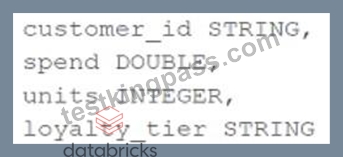
The customer_id column is the primary key in the feature set. Each of the columns in the feature set has missing values. They want to replace the missing values by imputing a common value for each feature.
Which of the following lists all of the columns in the feature set that need to be imputed using the most common value of the column?
- A. units
- B. customer_id, loyalty_tier
- C. customer_id
- D. spend
- E. loyalty_tier
Answer: E
Explanation:
For the feature set schema provided, the columns that need to be imputed using the most common value (mode) are typically the categorical columns. In this case, loyalty_tier is the only categorical column that should be imputed using the most common value. customer_id is a unique identifier and should not be imputed, while spend and units are numerical columns that should typically be imputed using the mean or median values, not the mode.
Reference:
Databricks documentation on missing value imputation: Handling Missing Data If you need any further clarification or additional questions answered, please let me know!
NEW QUESTION # 29
The implementation of linear regression in Spark ML first attempts to solve the linear regression problem using matrix decomposition, but this method does not scale well to large datasets with a large number of variables.
Which of the following approaches does Spark ML use to distribute the training of a linear regression model for large data?
- A. Spark ML cannot distribute linear regression training
- B. Logistic regression
- C. Singular value decomposition
- D. Iterative optimization
- E. Least-squares method
Answer: D
Explanation:
For large datasets with many variables, Spark ML distributes the training of a linear regression model using iterative optimization methods. Specifically, Spark ML employs algorithms such as Gradient Descent or L-BFGS (Limited-memory Broyden-Fletcher-Goldfarb-Shanno) to iteratively minimize the loss function. These iterative methods are suitable for distributed computing environments and can handle large-scale data efficiently by partitioning the data across nodes in a cluster and performing parallel updates.
Reference:
Spark MLlib Documentation (Linear Regression with Iterative Optimization).
NEW QUESTION # 30
Which statement describes a Spark ML transformer?
- A. A transformer is a hyperparameter grid that can be used to train a model
- B. A transformer is a learning algorithm that can use a DataFrame to train a model
- C. A transformer is an algorithm which can transform one DataFrame into another DataFrame
- D. A transformer chains multiple algorithms together to transform an ML workflow
Answer: C
Explanation:
In Spark ML, a transformer is an algorithm that can transform one DataFrame into another DataFrame. It takes a DataFrame as input and produces a new DataFrame as output. This transformation can involve adding new columns, modifying existing ones, or applying feature transformations. Examples of transformers in Spark MLlib include feature transformers like StringIndexer, VectorAssembler, and StandardScaler.
Reference:
Databricks documentation on transformers: Transformers in Spark ML
NEW QUESTION # 31
Which of the following statements describes a Spark ML estimator?
- A. An estimator is a trained ML model which turns a DataFrame with features into a DataFrame with predictions
- B. An estimator is an evaluation tool to assess to the quality of a model
- C. An estimator is a hyperparameter arid that can be used to train a model
- D. An estimator is an alqorithm which can be fit on a DataFrame to produce a Transformer
- E. An estimator chains multiple alqorithms toqether to specify an ML workflow
Answer: D
Explanation:
In the context of Spark MLlib, an estimator refers to an algorithm which can be "fit" on a DataFrame to produce a model (referred to as a Transformer), which can then be used to transform one DataFrame into another, typically adding predictions or model scores. This is a fundamental concept in machine learning pipelines in Spark, where the workflow includes fitting estimators to data to produce transformers.
Reference
Spark MLlib Documentation: https://spark.apache.org/docs/latest/ml-pipeline.html#estimators
NEW QUESTION # 32
A data scientist uses 3-fold cross-validation when optimizing model hyperparameters for a regression problem. The following root-mean-squared-error values are calculated on each of the validation folds:
* 10.0
* 12.0
* 17.0
Which of the following values represents the overall cross-validation root-mean-squared error?
- A. 13.0
- B. 17.0
- C. 12.0
- D. 39.0
- E. 10.0
Answer: A
Explanation:
To calculate the overall cross-validation root-mean-squared error (RMSE), you average the RMSE values obtained from each validation fold. Given the RMSE values of 10.0, 12.0, and 17.0 for the three folds, the overall cross-validation RMSE is calculated as the average of these three values:
Overall CV RMSE=10.0+12.0+17.03=39.03=13.0Overall CV RMSE=310.0+12.0+17.0=339.0=13.0 Thus, the correct answer is 13.0, which accurately represents the average RMSE across all folds.
Reference:
Cross-validation in Regression (Understanding Cross-Validation Metrics).
NEW QUESTION # 33
A data scientist is using Spark SQL to import their data into a machine learning pipeline. Once the data is imported, the data scientist performs machine learning tasks using Spark ML.
Which of the following compute tools is best suited for this use case?
- A. Single Node cluster
- B. SQL Warehouse
- C. None of these compute tools support this task
- D. Standard cluster
Answer: D
Explanation:
For a data scientist using Spark SQL to import data and then performing machine learning tasks using Spark ML, the best-suited compute tool is a Standard cluster. A Standard cluster in Databricks provides the necessary resources and scalability to handle large datasets and perform distributed computing tasks efficiently, making it ideal for running Spark SQL and Spark ML operations.
Reference:
Databricks documentation on clusters: Clusters in Databricks
NEW QUESTION # 34
Which of the following approaches can be used to view the notebook that was run to create an MLflow run?
- A. Click the "Source" link in the row corresponding to the run in the MLflow experiment page
- B. Open the MLmodel artifact in the MLflow run paqe
- C. Click the "Models" link in the row corresponding to the run in the MLflow experiment paqe
- D. Click the "Start Time" link in the row corresponding to the run in the MLflow experiment page
Answer: A
Explanation:
To view the notebook that was run to create an MLflow run, you can click the "Source" link in the row corresponding to the run in the MLflow experiment page. The "Source" link provides a direct reference to the source notebook or script that initiated the run, allowing you to review the code and methodology used in the experiment. This feature is particularly useful for reproducibility and for understanding the context of the experiment.
Reference:
MLflow Documentation (Viewing Run Sources and Notebooks).
NEW QUESTION # 35
A data scientist has replaced missing values in their feature set with each respective feature variable's median value. A colleague suggests that the data scientist is throwing away valuable information by doing this.
Which of the following approaches can they take to include as much information as possible in the feature set?
- A. Create a binary feature variable for each feature that contained missing values indicating whether each row's value has been imputed
- B. Create a constant feature variable for each feature that contained missing values indicating the percentage of rows from the feature that was originally missing
- C. Impute the missing values using each respective feature variable's mean value instead of the median value
- D. Remove all feature variables that originally contained missing values from the feature set
- E. Refrain from imputing the missing values in favor of letting the machine learning algorithm determine how to handle them
Answer: A
Explanation:
By creating a binary feature variable for each feature with missing values to indicate whether a value has been imputed, the data scientist can preserve information about the original state of the data. This approach maintains the integrity of the dataset by marking which values are original and which are synthetic (imputed). Here are the steps to implement this approach:
Identify Missing Values: Determine which features contain missing values.
Impute Missing Values: Continue with median imputation or choose another method (mean, mode, regression, etc.) to fill missing values.
Create Indicator Variables: For each feature that had missing values, add a new binary feature. This feature should be '1' if the original value was missing and imputed, and '0' otherwise.
Data Integration: Integrate these new binary features into the existing dataset. This maintains a record of where data imputation occurred, allowing models to potentially weight these observations differently.
Model Adjustment: Adjust machine learning models to account for these new features, which might involve considering interactions between these binary indicators and other features.
Reference
"Feature Engineering for Machine Learning" by Alice Zheng and Amanda Casari (O'Reilly Media, 2018), especially the sections on handling missing data.
Scikit-learn documentation on imputing missing values: https://scikit-learn.org/stable/modules/impute.html
NEW QUESTION # 36
Which of the following describes the relationship between native Spark DataFrames and pandas API on Spark DataFrames?
- A. pandas API on Spark DataFrames are less mutable versions of Spark DataFrames
- B. pandas API on Spark DataFrames are made up of Spark DataFrames and additional metadata
- C. pandas API on Spark DataFrames are more performant than Spark DataFrames
- D. pandas API on Spark DataFrames are single-node versions of Spark DataFrames with additional metadata
Answer: B
Explanation:
The pandas API on Spark DataFrames are made up of Spark DataFrames with additional metadata. The pandas API on Spark aims to provide the pandas-like experience with the scalability and distributed nature of Spark. It allows users to work with pandas functions on large datasets by leveraging Spark's underlying capabilities.
Reference:
Databricks documentation on pandas API on Spark: pandas API on Spark
NEW QUESTION # 37
An organization is developing a feature repository and is electing to one-hot encode all categorical feature variables. A data scientist suggests that the categorical feature variables should not be one-hot encoded within the feature repository.
Which of the following explanations justifies this suggestion?
- A. One-hot encoding is dependent on the target variable's values which differ for each apaplication.
- B. One-hot encoding is computationally intensive and should only be performed on small samples of training sets for individual machine learning problems.
- C. One-hot encoding is not a common strategy for representing categorical feature variables numerically.
- D. One-hot encoding is a potentially problematic categorical variable strategy for some machine learning algorithms.
Answer: D
Explanation:
The suggestion not to one-hot encode categorical feature variables within the feature repository is justified because one-hot encoding can be problematic for some machine learning algorithms. Specifically, one-hot encoding increases the dimensionality of the data, which can be computationally expensive and may lead to issues such as multicollinearity and overfitting. Additionally, some algorithms, such as tree-based methods, can handle categorical variables directly without requiring one-hot encoding.
Reference:
Databricks documentation on feature engineering: Feature Engineering
NEW QUESTION # 38
A machine learning engineer wants to parallelize the training of group-specific models using the Pandas Function API. They have developed the train_model function, and they want to apply it to each group of DataFrame df.
They have written the following incomplete code block: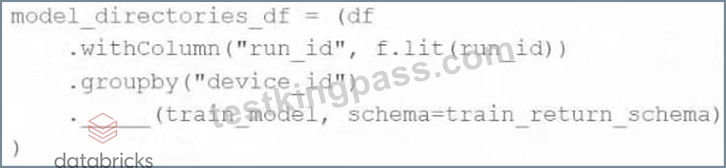
Which of the following pieces of code can be used to fill in the above blank to complete the task?
- A. predict
- B. groupedApplyIn
- C. applyInPandas
- D. train_model
- E. mapInPandas
Answer: E
Explanation:
The function mapInPandas in the PySpark DataFrame API allows for applying a function to each partition of the DataFrame. When working with grouped data, groupby followed by applyInPandas is the correct approach to apply a function to each group as a separate Pandas DataFrame. However, if the function should apply across each partition of the grouped data rather than on each individual group, mapInPandas would be utilized. Since the code snippet indicates the use of groupby, the intent seems to be to apply train_model on each group specifically, which aligns with applyInPandas. Thus, applyInPandas is a better fit to ensure that each group generated by groupby is processed through the train_model function, preserving the partitioning and grouping integrity.
Reference
PySpark Documentation on applying functions to grouped data: https://spark.apache.org/docs/latest/api/python/reference/api/pyspark.sql.GroupedData.applyInPandas.html
NEW QUESTION # 39
Which of the following machine learning algorithms typically uses bagging?
- A. IGradient boosted trees
- B. Random forest
- C. Decision tree
- D. K-means
Answer: B
Explanation:
Random Forest is a machine learning algorithm that typically uses bagging (Bootstrap Aggregating). Bagging is a technique that involves training multiple base models (such as decision trees) on different subsets of the data and then combining their predictions to improve overall model performance. Each subset is created by randomly sampling with replacement from the original dataset. The Random Forest algorithm builds multiple decision trees and merges them to get a more accurate and stable prediction.
Reference:
Databricks documentation on Random Forest: Random Forest in Spark ML
NEW QUESTION # 40
Which of the Spark operations can be used to randomly split a Spark DataFrame into a training DataFrame and a test DataFrame for downstream use?
- A. DataFrame.where
- B. TrainValidationSplit
- C. DataFrame.randomSplit
- D. TrainValidationSplitModel
- E. CrossValidator
Answer: C
Explanation:
The correct method to randomly split a Spark DataFrame into training and test sets is by using the randomSplit method. This method allows you to specify the proportions for the split as a list of weights and returns multiple DataFrames according to those weights. This is directly intended for splitting DataFrames randomly and is the appropriate choice for preparing data for training and testing in machine learning workflows.
Reference:
Apache Spark DataFrame API documentation (DataFrame Operations: randomSplit).
NEW QUESTION # 41
A data scientist learned during their training to always use 5-fold cross-validation in their model development workflow. A colleague suggests that there are cases where a train-validation split could be preferred over k-fold cross-validation when k > 2.
Which of the following describes a potential benefit of using a train-validation split over k-fold cross-validation in this scenario?
- A. Bias is avoidable when using a train-validation split
- B. Reproducibility is achievable when using a train-validation split
- C. Fewer models need to be trained when using a train-validation split
- D. A holdout set is not necessary when using a train-validation split
- E. Fewer hyperparameter values need to be tested when using a train-validation split
Answer: C
NEW QUESTION # 42
A data scientist is using Spark ML to engineer features for an exploratory machine learning project.
They decide they want to standardize their features using the following code block: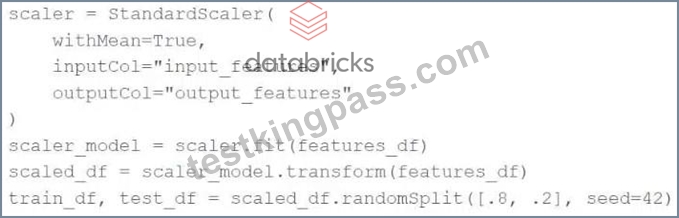
Upon code review, a colleague expressed concern with the features being standardized prior to splitting the data into a training set and a test set.
Which of the following changes can the data scientist make to address the concern?
- A. Utilize the MinMaxScaler object to standardize the test data according to global minimum and maximum values
- B. Utilize the Pipeline API to standardize the training data according to the test data's summary statistics
- C. Utilize the Pipeline API to standardize the test data according to the training data's summary statistics
- D. Utilize the MinMaxScaler object to standardize the training data according to global minimum and maximum values
- E. Utilize a cross-validation process rather than a train-test split process to remove the need for standardizing data
Answer: C
Explanation:
To address the concern about standardizing features prior to splitting the data, the correct approach is to use the Pipeline API to ensure that only the training data's summary statistics are used to standardize the test data. This is achieved by fitting the StandardScaler (or any scaler) on the training data and then transforming both the training and test data using the fitted scaler. This approach prevents information leakage from the test data into the model training process and ensures that the model is evaluated fairly.
Reference:
Best Practices in Preprocessing in Spark ML (Handling Data Splits and Feature Standardization).
NEW QUESTION # 43
......
Databricks Databricks-Machine-Learning-Associate Exam Syllabus Topics:
| Topic | Details |
|---|---|
| Topic 1 |
|
| Topic 2 |
|
| Topic 3 |
|
| Topic 4 |
|
Use Valid New Databricks-Machine-Learning-Associate Test Notes & Databricks-Machine-Learning-Associate Valid Exam Guide: https://passguide.testkingpass.com/Databricks-Machine-Learning-Associate-testking-dumps.html