


Latest Aug 09, 2026 NSE5_FNC_AD-7.6 Brain Dump: A Study Guide with Tips & Tricks for passing Exam
NSE5_FNC_AD-7.6 Question Bank: Free PDF Download Recently Updated Questions
NEW QUESTION # 35
What must an administrator configure to allow FortiNAC-F to process incoming syslog messages that are not supported by default?
- A. A Security Event Parser
- B. A Security Action
- C. A Syslog Service Connector
- D. A Log Receiver
Answer: A
Explanation:
FortiNAC-F provides a robust engine for processing security notifications from third-party devices.
For standard integrations, such as FortiGate or Check Point, the system comes pre-loaded with templates to interpret incoming data. However, when an administrator needs FortiNAC-F to process syslog messages from a vendor or device that is not supported by default, they must configure a Security Event Parser.
The Security Event Parser acts as the translation layer. It uses regular expressions (Regex) or specific field mappings to identify key data points within a raw syslog string, such as the source IP address, the threat type, and the severity. Without a parser, FortiNAC-F may receive the syslog message but will be unable to "understand" its contents, meaning it cannot generate the necessary Security Event required to trigger automated responses. Once a parser is created, the system can extract the host's IP address from the message, resolve it to a MAC address via L3 polling, and then apply the appropriate security rules. This allows for the integration of any security appliance capable of sending RFC-compliant syslog messages.
"FortiNAC parses the information based on pre-defined security event parsers stored in FortiNAC's database... If the incoming message format is not recognized, a new Security Event Parser must be created to define how the system should extract data fields from the raw syslog message. This enables FortiNAC to generate a security event and take action based on the alarm configuration."
NEW QUESTION # 36
Refer to the exhibit.
When configuring guest access using a network access policy, where would an administrator configure the Guest-VLAN value?
- A. In the Model configuration
- B. In the Guest portal configuration
- C. In the Guest template
- D. In the User/Host profile
Answer: A
Explanation:
The Guest-VLAN value is defined within the switch Model configuration, where VLAN mappings and enforcement actions are configured. The network access policy references this configuration to apply the appropriate VLAN when the policy conditions are met.
NEW QUESTION # 37
Refer to the exhibit. An administrator has configured the DHCP scope for a registration isolation network, but the isolation process isn't working.
What is the problem with the configuration?

- A. The label uses a system-reserved value.
- B. The lease pool does not contain a complete subnet.
- C. The gateway defined for the scope is incorrect.
- D. The domain name server designation is incorrect.
Answer: C
Explanation:
In a FortiNAC-F deployment, the configuration of the DHCP scope for isolation networks (Registration, Remediation, etc.) must perfectly align with the underlying network infrastructure to ensure that isolated hosts can communicate with the FortiNAC appliance. In the provided exhibits, there is a clear discrepancy between the DHCP configuration and the Network Topology.
As shown in the "Network Topology" exhibit, the Registration Network resides on a router interface (or sub-interface) with the IP address 192.168.180.1. This address represents the default gateway for any host placed into the Registration VLAN. However, the "DHCP configuration" exhibit shows the scope "REG-ScopeOne" configured with a Gateway of
10.0.1.254. This 10.0.1.254 address belongs to the management/service network (port2 of FortiNAC), not the registration subnet. If a host in the Registration VLAN receives this incorrect gateway via DHCP, it will attempt to send all off-link traffic to an unreachable IP, preventing it from loading the Captive Portal or communicating with the FortiNAC server.
According to the FortiNAC-F Configuration Wizard Reference, when defining a Layer 3 network scope, the "Gateway" field must contain the IP address of the router interface that acts as the gateway for that specific isolation VLAN. The FortiNAC appliance itself usually sits on a different subnet, and traffic is directed to it via the router's DHCP Relay (IP Helper) and DNS redirection.
"When configuring scopes for a Layer 3 network, the Gateway value must be the IP address of the router interface for that subnet. This allows the host to reach its local gateway to route traffic.
If the gateway is misconfigured, the host will be unable to reach the FortiNAC eth1/port2 interface for registration... Ensure the Gateway matches the network topology for the isolation VLAN."
NEW QUESTION # 38
An administrator wants to control user access to corporate resources by integrating FortiNAC-F with FortiGate using firewall tags defined on FortiNAC-F.
Where would the administrator assign the firewall tag value that will be sent to FortiGate?
- A. RADIUS group attribute
- B. Device profiling rule
- C. Logical network
- D. Security rule
Answer: C
Explanation:
In FortiNAC-F, the integration with FortiGate for Security Fabric and Single Sign-On (FSSO) allows the system to communicate the access level of an endpoint directly to the firewall using firewall tags. This eliminates the need for complex VLAN steering in some environments by allowing the FortiGate to apply policies based on these dynamic tags instead of just a physical or virtual network segment.
The actual assignment of the firewall tag value occurs within a Logical Network. In the FortiNAC- F architectural model, a Logical Network acts as a container for "Access Values". When an administrator configures a Logical Network (located under Network > Logical Networks), they define what that network represents--such as "Corporate Access" or "Contractor Limited". Within that definition, they assign the specific Firewall Tag that matches the tag created on the FortiGate. Once a user or host matches a Network Access Policy, FortiNAC-F identifies the associated Logical Network and pushes the defined tag to the FortiGate via the FSSO connector.
It is important to note that while Network Access Policies (and by extension Security Rules) are the logic engines that trigger the assignment, they do not hold the tag value itself. They simply point to a Logical Network, which serves as the central repository for that specific access configuration.
"To assign firewall tags, navigate to Network > Logical Networks. Select the desired logical network and click Edit. Under the Access Value section, select Firewall Tag as the type and enter the tag name exactly as it appears on the FortiGate. When a Network Access Policy matches a host, FortiNAC sends this tag to the FortiGate as an FSSO message."
NEW QUESTION # 39
Which agent can receive and display messages from FortiNAC to the end user?
- A. MDM
- B. Persistent
- C. Passive
- D. Dissolvable
Answer: B
NEW QUESTION # 40
A user was attempting to register their host through the registration captive portal. After successfully registering, the host remained in the registration VLAN. Which two conditions would cause this behavior? (Choose two.)
- A. There is no agent installed on the host.
- B. The port default VLAN is the same as the Registration VLAN.
- C. There is another unregistered host on the same port
- D. The wrong agent s installed.
Answer: B,C
Explanation:
The process of moving a host from a Registration VLAN to a Production VLAN (Access VLAN) is a fundamental part of the FortiNAC-F "VLAN steering" workflow. When a host successfully registers via the captive portal, FortiNAC-F evaluates its Network Access Policies to determine the correct VLAN. If the host remains stuck in the Registration VLAN despite a successful registration, it is typically due to port-level restrictions or the presence of other unregistered devices.
The two most common reasons for this behavior as per the documentation are:
The port default VLAN is the same as the Registration VLAN: If the "Default VLAN" field in the switch port's model configuration is set to the same ID as the Registration VLAN, the port will not change state because FortiNAC-F believes it is already in its "normal" or "forced" state.
There is another unregistered host on the same port: FortiNAC-F maintains the security posture of the physical port. If multiple hosts are connected to a single port (e.g., via a hub or unmanaged switch) and at least one host remains "Rogue" (unregistered), FortiNAC-F will generally keep the entire port in the isolation/registration VLAN to prevent the unregistered host from gaining unauthorized access to the production network.
NEW QUESTION # 41
Which two statements are true about integrating a third-party device using SNMP traps from that device as input to generate an event? (Choose two.)
- A. The sending device must support SNMPv3.
- B. The sending device must be modeled in the inventory topology.
- C. The IP address OID and MAC address OID must be configured in the trap MIB file.
- D. set allowaccess snmp must be configured using the CLI on the FortiNAC-F receiving interface.
Answer: B,C
Explanation:
The sending device must be modeled so FortiNAC-F can associate the incoming trap source with a known managed element and process it correctly. The trap definition must include the OIDs that carry the endpoint identifiers (IP and MAC) so FortiNAC-F can extract that data from the trap payload and generate the intended event.
NEW QUESTION # 42
When configuring FortiNAC-F to manage FortiGate VPN users, an endpoint compliance policy must be created for the integration.
Why is the endpoint compliance policy necessary for this type of integration?
- A. To confirm the installed endpoint certificate
- B. To validate the VPN user credentials
- C. To designate the required agent type
- D. To validate the VPN client being used
Answer: C
Explanation:
The integration of FortiNAC-F with FortiGate VPN requires a specific policy workflow to bridge the gap between initial user authentication and full network access. When a user connects to the VPN, the FortiGate typically provides the User ID and IP address, but FortiNAC-F requires a MAC address to uniquely identify and manage the endpoint's record.
According to the FortiGate VPN Integration Guide, the Endpoint Compliance Policy is a mandatory component of this setup because it is used to designate the required agent type.
Because a VPN connection is Layer 3, FortiNAC cannot "see" the MAC address through traditional SNMP or L2 polling. The compliance policy instructs the system to present a Captive Portal to the remote user, requiring them to download and run either the Persistent or Dissolvable Agent. The agent then reports the device's MAC address back to FortiNAC, allowing the system to correlate the VPN session with a host record.
Once the agent is running and the MAC is known, FortiNAC-F can evaluate the device's security posture (if scanning is configured) and send the necessary FSSO tags back to the FortiGate to lift the initial network restrictions. Without the compliance policy to enforce the agent requirement, the connection would remain in an isolated "IP-only" state with no unique hardware identity.
"The Endpoint Compliance Policy is necessary to control the agent requirement for VPN users.
Create a default VPN Endpoint Compliance Policy to distribute an agent via captive portal for isolated machines. This policy allows the administrator to designate the required agent type (Persistent or Dissolvable) that will be used to collect the hardware (MAC) address and perform health scans on the remote endpoint."
NEW QUESTION # 43
Refer to the exhibit. What will happen to the host of a guest user created from this template if the time of connection is 8:00 PM?
- A. The host will be marked as a rogue device.
- B. The host will be marked as non-authenticated.
- C. The host will be administratively disabled.
- D. The host will be marked as at-risk.
Answer: B
Explanation:
In FortiNAC-F, the Guest & Contractor Template is a configuration object that defines the parameters for accounts created by sponsors or through self-registration. One of the critical security controls within this template is the Login Availability setting. This setting restricts the specific days and times during which a guest or contractor is permitted to authenticate and access the network.
As shown in the exhibit, the "StandardGuest" template has Login Availability set to "Specify Time", with a schedule defined as Mon-Fri, 6:00 AM to 7:00 PM. If a guest user attempts to connect or authenticate at 8:00 PM, which is outside of the permitted window, FortiNAC-F's policy engine will automatically deny the authentication request. When an authentication attempt is denied due to schedule restrictions, the system does not move the host into the "Authenticated" or "Registered" state required for production access. Instead, the host is marked as non- authenticated in the adapter or host view.
NEW QUESTION # 44
An administrator wants each department to create and manage its own contractor accounts but not be able to manage contractor accounts for other departments.
What must the administrator configure to limit the sponsor's capabilities?
- A. The user/host profile applied to the contractor
- B. The portal settings on the kiosk portal page
- C. The contractor's template
- D. The sponsor's administrative profile
Answer: D
Explanation:
The sponsor's administrative profile defines the scope of management permissions, including which accounts they can create, view, and modify. By restricting the administrative profile to a specific department, each sponsor can manage only their own department's contractor accounts and not those of other departments.
NEW QUESTION # 45
During an evaluation of state-based enforcement, an administrator discovers that ports that should not be under enforcement have been added to enforcement groups.
In which view would the administrator be able to identify who added the ports to the groups?
- A. The Admin Auditing view
- B. The Event Management view
- C. The Port Changes view
- D. The Security Events view
Answer: A
Explanation:
In FortiNAC-F, accountability and forensic tracking of configuration changes are managed through the Admin Auditing functionality. When an administrator performs an action that modifies the system state--such as creating a policy, changing a device's status, or adding a switch port to an Enforcement Group--the system generates an audit record. This record is essential for troubleshooting scenarios where unauthorized or accidental configuration changes have occurred, leading to unintended network behavior.
The Admin Auditing view (found under Logs > Admin Auditing) provides a comprehensive log of the "Who, What, and When" for every administrative session. Each entry includes the username of the administrator, the source IP address from which they accessed the FortiNAC-F console, a precise timestamp, and a detailed description of the modification. In the scenario described, where port have been incorrectly added to enforcement groups, the Admin Auditing view allows a supervisor to filter by the specific "Port" or "Group" object to identify exactly which administrator executed the command.
NEW QUESTION # 46
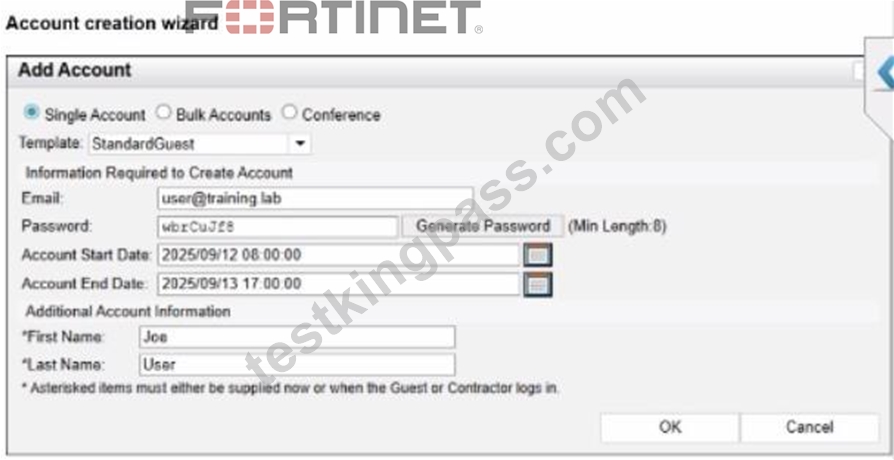
Refer to the exhibits. Based on the given configurations and settings, on which date and time would a guest account created at 8:00 AM on 2025/09/12 expire?
- A. 2025/09/12 at 17:00:00
- B. 2025/09/12 at 8:00 PM
- C. 2025/09/13 at 17:00:00
- D. 2025/09/12 at 7:00 PM
Answer: C
Explanation:
In FortiNAC-F, the expiration of a guest or contractor account is determined by the configuration settings within the Account Creation Wizard and the associated Guest/Contractor Template.
While a template can define a default "Account Duration" (as seen in the 12-hour setting in the second exhibit), the Account Creation Wizard allows an administrator to manually specify or override the start and end parameters for a specific user session.
According to the FortiNAC-F Administration Guide regarding guest management, the Account End Date field in the creation wizard is the definitive timestamp for when the account object will be disabled or deleted from the system. In the provided exhibit (Account Creation Wizard), the administrator has explicitly set the Account Start Date to 2025/09/12 08:00:00 and the Account End Date to 2025/09/13 17:00:00.
Even though the template indicates an "Account Duration" of 12 hours, this value typically serves as a pre-populated default. When a manual date and time are entered into the wizard, those specific values take precedence for that individual account. The account will remain active and valid until 5:00 PM (17:00:00) on the following day, 2025/09/13. It is also important to note the
"Login Availability" from the template (8:00 AM - 7:00 PM); while the account exists until the 13th at 17:00:00, the user would only be able to authenticate during the active hours defined by the login schedule on both days.
"When creating an account, the administrator can select a template to provide default settings.
However, specific values such as the Account End Date can be modified within the Account Creation Wizard. The date and time specified in the 'Account End Date' field determines the absolute expiration of the account. Once this time is reached, the account is moved to an expired state and the user's network access is revoked."
NEW QUESTION # 47
Which two actions must the administrator perform to allow FortiNAC-F to process incoming syslog messages from an unknown vendor? (Choose two.)
- A. The device must have an event parser created for it.
- B. The device must be added as a server in the Host view
- C. The device sending the messages must be modeled in the Network Inventory view
- D. The device must be added as a log receiver in FortiNAC-F.
Answer: A,C
Explanation:
An event parser must be created so FortiNAC-F can interpret and extract meaningful data from the unknown vendor's syslog messages. The sending device must be modeled in the Network Inventory so FortiNAC-F can associate the incoming syslog messages with a known device and properly process the generated events.
NEW QUESTION # 48
Refer to the exhibit.
After a successful layer 2 poll, two hosts were learned on the same port. The port is a member of the Role-Based Access and Forced Registration groups. The switch has been configured to leverage a single isolation VLAN.
How will FortiNAC-F manage this port?
- A. The port will be provisioned as an uplink to a hub or unmanaged switch.
- B. The port will be provisioned to the isolation network.
- C. The port will be added to the Access Point Management group.
- D. The port will be provisioned for the normal state host, but the second host will have access to only the isolation portal page.
Answer: B
Explanation:
Because two hosts were learned on the same switch port, FortiNAC-F must enforce access at the port level rather than per-host. With a single isolation VLAN configured, the port is placed into the isolation network to ensure the port's learned devices are restricted and can be forced through the registration/isolation workflow.
NEW QUESTION # 49
During the testing of a newly modeled infrastructure switch, the administrator is not seeing hosts as they connect or move from one port to another.
What would cause this issue?
- A. Contact polling is not configured.
- B. MAC notification traps are misconfigured.
- C. Layer 3 polling is failing.
- D. The default scheduled polling is disabled.
Answer: B
Explanation:
FortiNAC-F relies on correctly configured MAC notification (link) traps to detect hosts connecting or moving between ports in real time. If these traps are misconfigured, the system will not receive port-level MAC change events, so newly connected or moved hosts will not be detected as expected.
NEW QUESTION # 50
Refer to the exhibit.
Which devices are automatically evaluated by these device profiling rules?
- A. Rogue devices, only when they are initially added to the database
- B. Known trusted devices, each time they connect
- C. Rogue devices, each time they change location
- D. All hosts, each time they connect
Answer: A
Explanation:
The profiling rules are configured with automatic registration and rely on vendor OUI and location methods. These rules evaluate devices when they are first identified as rogues and added to the database, at which point profiling determines whether they should be registered as devices.
NEW QUESTION # 51
......
New NSE5_FNC_AD-7.6 Exam Dumps with High Passing Rate: https://passguide.testkingpass.com/NSE5_FNC_AD-7.6-testking-dumps.html