


[Nov-2023] Microsoft AZ-220 Official Cert Guide PDF
Exam AZ-220: Microsoft Azure IoT Developer - Prep4away
NEW QUESTION # 108
You have an Azure IoT solution that includes an Azure IoT hub and 50 IoT devices. The device twins have the following structure.
You need to configure message enrichments to add the following values to messages:
* The device deployment location
* The device firmware version
How should you configure the message enrichments? To answer, select the appropriate options in the answer area.
NOTE: Each correct selection is worth one point.
Answer:
Explanation:
Explanation
NEW QUESTION # 109
You have an Azure subscription that contains a resource group named RG1.
You need to deploy the Device Provisioning Service. The solution must ensure that the Device Provisioning Service can accept new device enrollments.
You create a Device Provisioning Service instance.
Which two actions should you perform next? Each correct answer presents part of the solution.
NOTE: Each correct selection is worth one point.
- A. From the Linked IoT hubs blade of the Device Provisioning Service, link an Azure IoT hub.
- B. From the Azure portal, create a new Azure IoT hub.
- C. From the Certificates blade of the Device Provisioning Service, upload an X.509 certificate to the Device Provisioning Service.
- D. From the Manage allocation policy blade of the Device Provisioning Service, configure an allocation policy.
Answer: C
Explanation:
A: The Device Provisioning Service can only provision devices to IoT hubs that have been linked to it.
C: Allocation policy. The service-level setting that determines how Device Provisioning Service assigns devices to an IoT hub. There are three supported allocation policies:
Lowest latency: devices are provisioned to an IoT hub with the lowest latency to the device. Evenly weighted distribution Static configuration via the enrollment list Reference:
https://docs.microsoft.com/bs-latn-ba/azure/iot-dps/concepts-service
NEW QUESTION # 110
You have an Azure IoT hub that uses a Device Provision Service instance.
You plan to deploy 100 IoT devices.
You need to confirm the identity of the devices by using the Device Provision Service.
Which three device attestation mechanisms can you use? Each correct answer presents a complete solution.
NOTE: Each correct selection is worth one point.
- A. Trusted Platform Module (TPM) 1.2
- B. X.509 certificates
- C. Trusted Platform Module (TPM) 2.0
- D. Symmetric key
- E. Device Identity Composition Engine (DICE)
D18912E1457D5D1DDCBD40AB3BF70D5D
Answer: B,C,D
Explanation:
Explanation
The Device Provisioning Service supports the following forms of attestation:
* X.509 certificates based on the standard X.509 certificate authentication flow.
* Trusted Platform Module (TPM) based on a nonce challenge, using the TPM 2.0 standard for keys to present a signed Shared Access Signature (SAS) token. This does not require a physical TPM on the device, but the service expects to attest using the endorsement key per the TPM spec.
* Symmetric Key based on shared access signature (SAS) Security tokens, which include a hashed signature and an embedded expiration.
Reference:
https://docs.microsoft.com/en-us/azure/iot-dps/concepts-service#attestation-mechanism
NEW QUESTION # 111
You have an Azure loT hub
You have four Azure 10T Edge devices and. The device twin code shown in the following table.
You have three deployments and the deployment code shown in the following table.
For each of the following statements, select Yes if the statement is true. Otherwise, select No. NOTE: Each correct selection is worth one point.
Answer:
Explanation:
Explanation
NEW QUESTION # 112
You are planning a proof of concept (POC) that will use an Azure IoT hub.
You have two self-signed client authentication certificates named Cert1 and Cert2. Cert1 has a basic constraint that contains Subject Type=C You need to identify which certificates to use.
What should you identify? To answer, select the appropriate options in the answer area.
NOTE: Each correct selection is worth one point.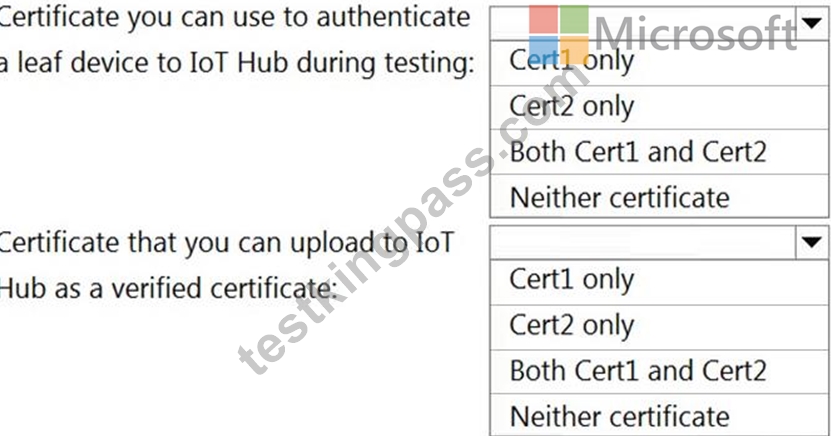
Answer:
Explanation:
Reference:
https://docs.microsoft.com/en-us/azure/iot-dps/concepts-x509-attestation
NEW QUESTION # 113
You have an Azure loT hub and an Azure virtual network.
You configure a private endpoint for the IoT hub.
You need to ensure that the loT hub can send data to downstream services What should you create first?
- A. an IP filter rule
- B. a message route
- C. a managed identity
- D. a consumer group
Answer: A
NEW QUESTION # 114
You have an Azure subscription that contains an Azure IoT hub and two IoT devices named Device1 and Device2.
You plan to deploy an Azure IoT Edge gateway device named Gateway1.
You need to ensure that all device-to-cloud messages and twin change notifications from Device1 and Device2 to the IoT hub are routed by using Gateway1.
What tasks should you perform to configure the devices? To answer, select the appropriate options in the answer area.
NOTE: Each correct selection is worth one point.
Answer:
Explanation:
Reference:
https://docs.microsoft.com/en-us/azure/iot-edge/how-to-authenticate-downstream-device
NEW QUESTION # 115
Note: This question is part of a series of questions that present the same scenario. Each question in the series contains a unique solution that might meet the stated goals. Some question sets might have more than one correct solution, while others might not have a correct solution.
After you answer a question in this question, you will NOT be able to return to it. As a result, these questions will not appear in the review screen.
You have devices that connect to an Azure IoT hub. Each device has a fixed GPS location that includes latitude and longitude.
You discover that a device entry in the identity registry of the IoT hub is missing the GPS location.
You need to configure the GPS location for the device entry. The solution must prevent the changes from being propagated to the physical device.
Solution: You use an Azure policy to apply tags to a resource group. Does the solution meet the goal?
- A. Yes
- B. No
Answer: B
Explanation:
Instead add the desired properties to the device twin.
Note: Device Twins are used to synchronize state between an IoT solution's cloud service and its devices. Each device's twin exposes a set of desired properties and reported properties. The cloud service populates the desired properties with values it wishes to send to the device. When a device connects it requests and/or subscribes for its desired properties and acts on them.
Reference:
https://azure.microsoft.com/sv-se/blog/deep-dive-into-azure-iot-hub-notifications-and-device-twin/
NEW QUESTION # 116
You have an Azure IoT hub that uses a Device Provisioning Service instance.
You create a new individual device enrollment that uses symmetric key attestation.
Which detail from the enrollment is required to auto provision the device by using the Device Provisioning Service?
- A. the registration ID of the enrollment
- B. the primary key of the enrollment
- C. the device identity of the IoT hub
- D. the hostname of the IoT hub
Answer: C
NEW QUESTION # 117
You plan to deploy a standard tier Azure IoT hub.
You need to perform an over-the-air (OTA) update on devices that will connect to the IoT hub by using scheduled jobs.
What should you use?
- A. a direct method
- B. a cloud-to-device message
- C. a device-to-cloud message
- D. the device twin reported properties
Answer: A
Explanation:
Explanation
Releases via the REST API.
All of the operations that can be performed from the Console can also be automated using the REST API. You might do this to automate your build and release process, for example.
You can build firmware using the Particle CLI or directly using the compile source code API.
Note: Over-the-air (OTA) firmware updates are a vital component of any IoT system. Over-the-air firmware updates refers to the practice of remotely updating the code on an embedded device.
Reference:
https://docs.particle.io/tutorials/device-cloud/ota-updates/
NEW QUESTION # 118
You have an Azure IoT Central application.
You need to connect an IoT device to the application.
Which two settings do you require in IoT Central to configure the device? Each correct answer presents part of the solution.
NOTE: Each correct selection is worth one point.
- A. Group SAS Primary Key
- B. Device ID
- C. the IoT hub name
- D. Scope ID
- E. Application Name
Answer: B,D
Explanation:
In your Azure IoT Central application, add a real device to the device template
1. On the Devices page, select the Environmental sensor device template.
2. Select + New.
3. Make sure that Simulated is Off. Then select Create.
Click on the device name, and then select Connect. Make a note of the device connection information on the Device Connection page - ID scope, Device ID, and Primary key. You need these values when you create your device code:
Reference:
https://docs.microsoft.com/bs-cyrl-ba/azure/iot-central/core/tutorial-connect-device-python
NEW QUESTION # 119
You have an Azure Stream Analytics job that connects to an Azure IoT hub named Hub1445 as a streamingdata source. Hub1445 is configured as shown in the exhibit. (Click the Exhibit tab.)
The Stream Analytics job fails to receive any messages from the IoT hub. What should you do to resolve the issue?
- A. Change the Route1 route query to true.
- B. Enable the Route3 route.
- C. Disable the Route2 route.
- D. Enable the fallback route.
Answer: A
Explanation:
The device telemetry is usually passed as JSON from the device through the IoT Hub - this is handled nicely by Azure Streaming Analytics queries.
The IoT Hub message routing should be configured as follows: Data source: Device Telemetry Messages Routing query: true (as the routing query is an expression that evaluates to true or false for each received message, the simplest way to send all messages to the endpoint is to just supply true as the query).
Reference:
https://darenmay.com/blog/azure-iot-streaming-analytics-data-lake-analytics-and-json/
NEW QUESTION # 120
Note: This question is part of a series of questions that present the same scenario. Each question in the series contains a unique solution that might meet the stated goals. Some question sets might have more than one correct solution, while others might not have a correct solution.
After you answer a question in this section, you will NOT be able to return to it. As a result, these questions will not appear in the review screen.
You have an Azure IoT solution that includes an Azure IoT hub and an Azure IoT Edge device.
You plan to deploy 10 Bluetooth sensors. The sensors do not support MQTT, AMQP, or HTTPS.
You need to ensure that all the sensors appear in the IoT hub as a single device.
Solution: You configure the IoT Edge device as an IoT Edge transparent gateway. You configure the sensors to connect to the device.
Does this meet the goal?
- A. Yes
- B. No
Answer: B
Explanation:
IoT Edge transparent gateways support only the MQTT or AMQP protocols.
Instead use a translation gateway.
IoT Hub. The translation module receives messages from downstream devices, translates them into a supported protocol, and then the IoT Edge device sends the messages on behalf of the downstream devices. All information looks like it is coming from one device, the gateway.
Reference:
https://docs.microsoft.com/en-us/azure/iot-edge/iot-edge-as-gateway
NEW QUESTION # 121
You create an Azure Stream Analytics job that has the following query.
The job is configured to have an Azure IoT Hub input and an output to an Azure function.
For each of the following statements, select Yes if the statement is true. Otherwise, select No.
NOTE: Each correct selection is worth one point.
Answer:
Explanation:
Explanation:
Box 1: Yes
All time handling operations in Azure Stream Analytics are in UTC.
Box 2: No
Tumbling windows are a series of fixed-sized, non-overlapping and contiguous time intervals.
Box 3: Yes
Reference:
https://docs.microsoft.com/en-us/stream-analytics-query/time-management-azure-stream-analytics
NEW QUESTION # 122
You have an Azure subscription that contains an Azure IoT hub and two IoT devices named Device1 and Device2.
You plan to deploy an Azure IoT Edge gateway device named Gateway1.
You need to ensure that all device-to-cloud messages and twin change notifications from Device1 and Device2 to the IoT hub are routed by using Gateway1.
What tasks should you perform to configure the devices? To answer, select the appropriate options in the answer area.
NOTE: Each correct selection is worth one point.
Answer:
Explanation:
Reference:
https://docs.microsoft.com/en-us/azure/iot-edge/how-to-authenticate-downstream-device
NEW QUESTION # 123
DRAG DROP
You need to install the Azure IoT Edge runtime on a new device that runs Windows 10 IoT Enterprise.
Which four actions should you perform in sequence? To answer, move the appropriate actions from the list of actions to the answer area and arrange them in the correct order.
Select and Place: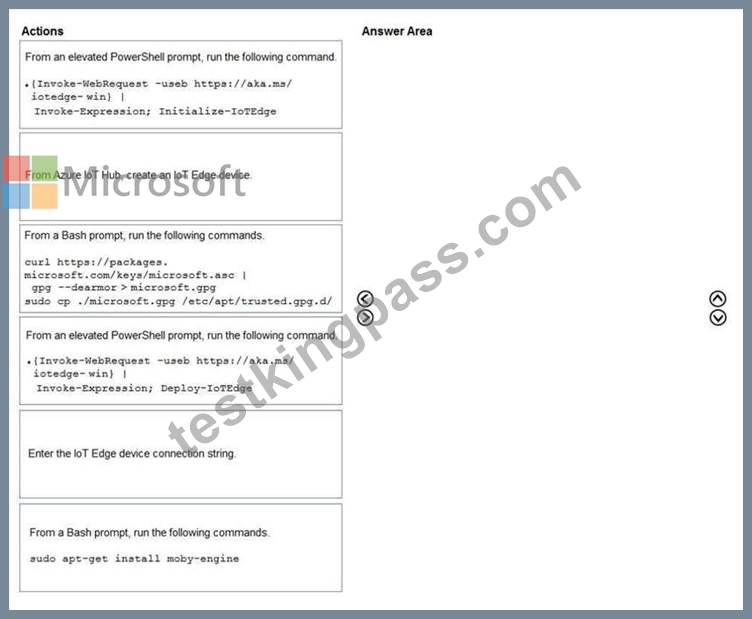
Answer:
Explanation:
Explanation:
Step 1: From Azure IoT Hub, create an IoT Edge Device
Step 2: Deploy-IoTEdge
The Deploy-IoTEdge command checks that your Windows machine is on a supported version, turns on the containers feature, and then downloads the moby runtime and the IoT Edge runtime. The command defaults to using Windows containers.
{Invoke-WebRequest -useb https://aka.ms/iotedge-win} | Invoke-Expression; ` Deploy-IoTEdge Step 3: Initialize-IoTEdge The Initialize-IoTEdge command configures the IoT Edge runtime on your machine. The command defaults to manual provisioning with Windows containers.
{Invoke-WebRequest -useb https://aka.ms/iotedge
Step 4: Enter the IoT Edge device connection string.
When prompted, provide the device connection string that you retrieved in step 1. The device connection string associates the physical device with a device ID in IoT Hub.
Reference:
https://docs.microsoft.com/en-us/azure/iot-edge/module-composition
NEW QUESTION # 124
......
Free AZ-220 Exam Dumps to Improve Exam Score: https://passguide.testkingpass.com/AZ-220-testking-dumps.html