


[Aug-2024] AZ-104 Dumps PDF - AZ-104 Real Exam Questions Answers
AZ-104 Dumps 100% Pass Guarantee With Latest Demo
For more info read reference:
Microsoft learning site Administer infrastructure resources in Azure Azure Storage Azure Network
NEW QUESTION # 26
You have an Azure subscription that contains a virtual network named VNet1. VNet1 uses an IP address space of 10.0.0.0/16 and contains the subnets in the following table.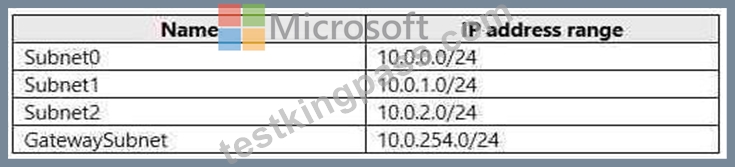
Subnet1 contains a virtual appliance named VM1 that operates as a router.
You create a routing table named RT1.
You need to route all inbound traffic to VNet1 through VM1.
How should you configure RT1? To answer, select the appropriate options in the answer area.
NOTE: Each correct selection is worth one point.
Answer:
Explanation: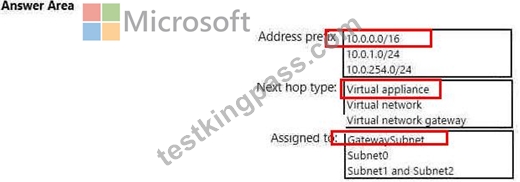
Reference:
https://docs.microsoft.com/en-us/azure/virtual-network/manage-route-table#create-a-route-table
https://docs.microsoft.com/en-us/azure/network-watcher/network-watcher-next-hop-overview
NEW QUESTION # 27
You have an Azure subscription. The subscription contains virtual machines that run Windows Server 2016 and are configured as shown in the following table.

Answer:
Explanation:
NEW QUESTION # 28
You plan to use Azure Network Watcher to perform the following tasks:
Task1: Identify a security rule that prevents a network packet from reaching an Azure virtual machine Task2: Validate outbound connectivity from an Azure virtual machine to an external host Which feature should you use for each task? To answer, select the appropriate options in the answer area.
NOTE: Each correct selection is worth one point.
Answer:
Explanation: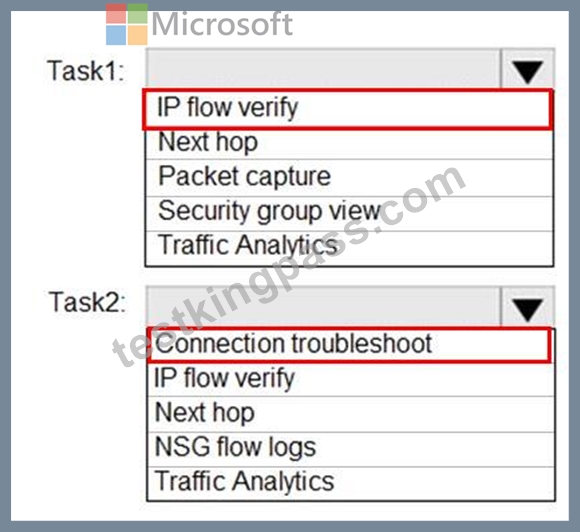
Reference:
https://docs.microsoft.com/en-us/azure/network-watcher/network-watcher-monitoring-overview
https://docs.microsoft.com/en-us/azure/network-watcher/network-watcher-ip-flow-verify-overview
https://docs.microsoft.com/en-us/azure/network-watcher/network-watcher-connectivity-overview
NEW QUESTION # 29
You have an Azure subscription.
You need to deploy a virtual machine by using an Azure Resource Manager (ARM) template.
How should you complete the template? To answer, select the appropriate options in the answer area.
NOTE: Each correct selection is worth one point.
Answer:
Explanation:
Answer is in image below.
NEW QUESTION # 30
You have an Azure subscription named Subscription1 that contains the resources shown in the following table.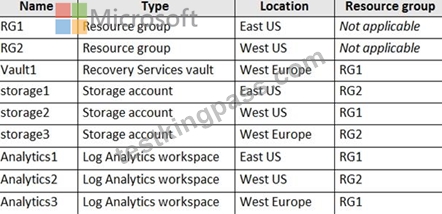
You plan to configure Azure Backup reports for Vault1.
You are configuring the Diagnostics settings for the AzureBackupReports log.
Which storage accounts and which Log Analytics workspaces can you use for the Azure Backup reports of Vault1? To answer, select the appropriate options in the answer area.
NOTE: Each correct selection is worth one point.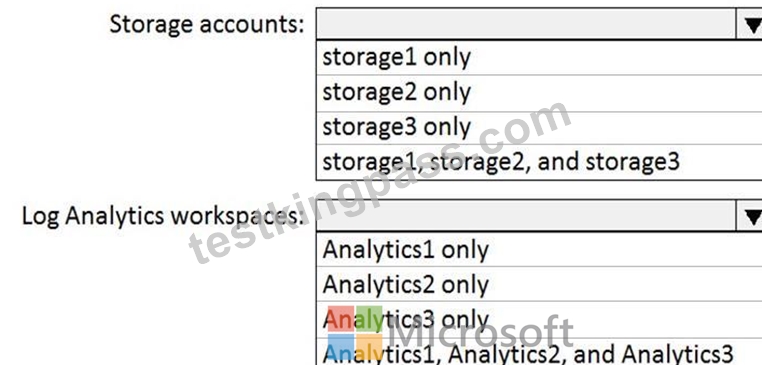
Answer:
Explanation:
Box 1: storage3 only
Vault1 and storage3 are both in West Europe.
Box 2: Analytics1, Analytics2, Analytics3
https://docs.microsoft.com/en-us/azure/backup/backup-create-rs-vault
https://docs.microsoft.com/de-de/azure/backup/configure-reports
NEW QUESTION # 31
You have an Azure subscription that contains the resources shown in the following table
In Azure Cloud Shell, you need to create a virtual machine by using an Azure Resource Manager (ARM) template.
How should you complete the command? To answer, select the appropriate options in the answer area, NOTE: Each correct selection is worth one point.
Answer:
Explanation:
NEW QUESTION # 32
You have an Azure subscription named Subscription1 that has the following providers registered:
* Authorization
* Automation
* Resources
* Compute
* KeyVault
* Network
* Storage
* Billing
* Web
Subscription1 contains an Azure virtual machine named VM1 that has the following con figurations:
* Private IP address: 10.0.0.4 (dynamic)
* Network security group (NSG): NSG1
* Public IP address: None
* Availability set: AVSet
* Subnet: 10.0.0.0/24
* Managed disks: No
* Location: East US
You need to record all the successful and failed connection attempts to VM1.
Which three actions should you perform? Each correct answer presents part of the solution.
NOTE: Each correct selection is worth one point.
- A. Create an Azure Storage account
- B. Enable Azure Network Watcher flow logs
- C. Register the Microsoft.LogAnalytics provider
- D. Enable Azure Network Watcher in the East US Azure region
- E. Add an Azure Network Watcher connection monitor
- F. Register the Microsoft.Insights resource provider
Answer: A,C,D
Explanation:
NSG flow log data is written to an Azure Storage account. You need to create an Azure Storage account, With an Azure Storage account NSG flow logs can be enabled.
Enable network watcher in the East US region.
NSG flow logging requires the Microsoft.Insights provider.
References:
https://docs.microsoft.com/en-us/azure/network-watcher/network-watcher-nsg-flow-logging-portal
NEW QUESTION # 33
You need to create an Azure Storage account that meets the following requirements:
* Minimizes costs
* Supports hot, cool, and archive blob tiers
* Provides fault tolerance if a disaster affects the Azure region where the account resides How should you complete the command? To answer, select the appropriate options in the answer area. NOTE:
Each correct selection is worth one point
Answer:
Explanation:
Explanation
Box 1: StorageV2
You may only tier your object storage data to hot, cool, or archive in Blob storage and General Purpose v2 (GPv2) accounts. General Purpose v1 (GPv1) accounts do not support tiering.
General-purpose v2 accounts deliver the lowest per-gigabyte capacity prices for Azure Storage, as well as industry-competitive transaction prices.
Box 2: Standard_GRS
Geo-redundant storage (GRS): Cross-regional replication to protect against region-wide unavailability.
NEW QUESTION # 34
You are creating an Azure load balancer.
You need to add an IPv6 load balancing rule to the load balancer.
How should you complete the Azure PowerShell script? To answer, select the appropriate options in the answer area.
NOTE: Each correct selection is worth one point.
Answer:
Explanation:
Reference:
https://docs.microsoft.com/en-us/azure/load-balancer/load-balancer-ipv6-internet-ps
NEW QUESTION # 35
You have an Azure subscription named Subscription1 that contains the resources shown in the following table.
The status of VM1 is Running.
You assign an Azure policy as shown in the exhibit. (Click the Exhibit tab.)
You assign the policy by using the following parameters:
For each of the following statements, select Yes if the statement is true. Otherwise, select No.
NOTE: Each correct selection is worth one point.
Answer:
Explanation:
Reference:
https://docs.microsoft.com/en-us/azure/governance/policy/assign-policy-portal
NEW QUESTION # 36
You have an Azure virtual machine named VM1 and a Recovery Services vault named Vault1.
You create a backup Policy1 as shown in the exhibit. (Click the Exhibit tab.)
You configure the backup of VM1 to use Policy1 on Thursday, January 1.
You need to identify the number of available recovery points for VM1.
How many recovery points are available on January 8 and on January 15? To answer, select the appropriate options in the answer area.
NOTE: Each correct selection is worth one point.
Answer:
Explanation:
Explanation:
Box 1: 6
4 daily + 1 weekly + monthly
Box 2: 8
4 daily + 2 weekly + monthly + yearly
NEW QUESTION # 37
You have an Azure subscription.
You deploy a virtual machine scale set that is configure as shown in the following exhibit.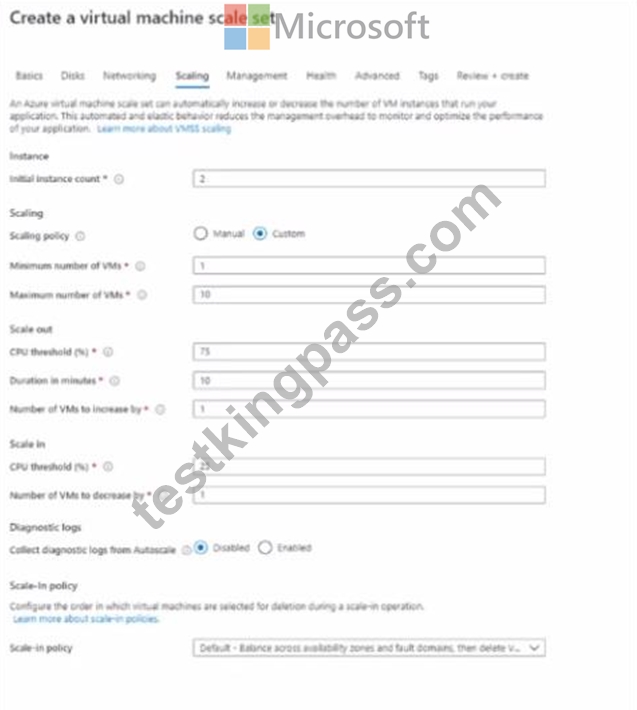
Use the drop-down menus to select the answer choice that answers each questions based on the information presented in the graphic.
NOTE: Each correct selection is worth one point.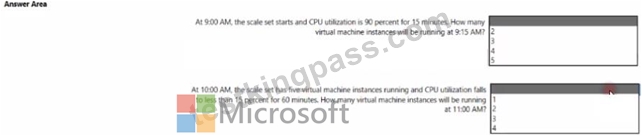
Answer:
Explanation:
NEW QUESTION # 38
You have an Azure subscription that contains the following resources:
* a virtual network named VNet1
* a replication policy named ReplPolicy1
* a Recovery Services vault named Vault1
* an Azure Storage account named Storage1
You have an Amazon Web Services (AWS) EC2 virtual machine named VM1 that runs Windows Server You need to migrate VM1 to VNet1 by using Azure Site Recovery.
Which three actions should you perform in sequence? To answer, move the appropriate actions from the list of actions to the answer area and arrange them in the correct order.
Answer:
Explanation:
Explanation:
Step 1: Deploy an EC2 virtual machine as a configuration server
Prepare source include:
* Use an EC2 instance that's running Windows Server 2012 R2 to create a configuration server and register it with your recovery vault.
* Configure the proxy on the EC2 instance VM you're using as the configuration server so that it can access the service URLs.
Step 2: Install Azure Site Recovery Unified Setup.
Download Microsoft Azure Site Recovery Unified Setup. You can download it to your local machine and then copy it to the VM you're using as the configuration server.
Step 3: Enable replication for VM1.
Enable replication for each VM that you want to migrate. When replication is enabled, Site Recovery automatically installs the Mobility service.
References:
https://docs.microsoft.com/en-us/azure/site-recovery/migrate-tutorial-aws-azure
NEW QUESTION # 39
You onboard 10 Azure virtual machines to Azure Automation State Configuration.
You need to use Azure Automation State Configuration to manage the ongoing consistency of the virtual machine configurations.
Which three actions should you perform in sequence? To answer, move the appropriate actions from the list of actions to the answer area and arrange them in the correct order.
NOTE: More than one order of answer choices is correct. You will receive credit for any of the correct orders you select.
Answer:
Explanation:
1 - Upload a configuration to Azure Automation State Configuration.
2 - Compile a configuration into a node configuration.
3 - Assign the node configuration
4 - Check the compliance status of the node
Reference:
https://docs.microsoft.com/en-us/azure/automation/automation-dsc-getting-started
NEW QUESTION # 40
You create a Recovery Services vault backup policy named Policy1 as shown in the following exhibit:

Use the drop-down menus to select the answer choice that completes each statement based on the information presented in the graphic.
NOTE: Each correct selection is worth one point.
Answer:
Explanation:
NEW QUESTION # 41
......
Schedule exam
Languages: English, Chinese (Simplified), Korean, Japanese, French, German, Spanish
Retirement date: none
This exam measures your ability to accomplish the following technical tasks: manage Azure identities and governance; implement and manage storage; deploy and manage Azure compute resources; configure and manage virtual networking; and monitor and back up Azure resources.
Dumps Real Microsoft AZ-104 Exam Questions [Updated 2024]: https://passguide.testkingpass.com/AZ-104-testking-dumps.html