


AZ-104 Exam Dumps - Try Best AZ-104 Exam Questions from Training Expert Prep4away
Practice Examples and Dumps & Tips for 2024 Latest AZ-104 Valid Tests Dumps
Microsoft AZ-104 exam is a certification assessment that has been designed to test the knowledge and skills of individuals who wish to become Microsoft Azure Administrators. AZ-104 exam is the replacement for the previous Microsoft AZ-103 certification exam, and it is intended for those who are responsible for managing and monitoring Azure resources and services.
Microsoft AZ-104 Certification Exam is designed for individuals who want to become proficient in the management and administration of Microsoft Azure technologies. Microsoft Azure Administrator certification focuses on the skills required to manage Azure resources, configure and manage virtual networks, implement and manage storage solutions, and monitor and backup Azure resources. It is a globally recognized certification that validates the skills required to perform Azure administration tasks.
Intended Target Audience for Microsoft AZ-104 Exam
The Microsoft AZ-104 exam is designed for those Azure enthusiasts who want to work with the platform. It is advisable for anyone going for this certification test to have at least 6 months of experience with the Microsoft Azure platform. The individuals should also have a good understanding of all the Azure concepts and workloads as well as have knowledge pertaining to Cloud infrastructure, operating systems, networking, storage structures, and virtualization. Other than that, you should be well-versed with ARM templates, PowerShell, Azure Portal, and Command Line Interface. If you don’t fulfill these criteria, you might not be able to get the required score in the AZ-104 exam.
NEW QUESTION # 80
You have a Recovery Services vault named RSV1. RSV1 has a backup policy that retains instant snapshots for five days and daily backup for 14 days.
RSV1 performs daily backups of VM1. VM1 hosts a static website that was updated eight days ago.
You need to recover VM1 to a point eight days ago. The solution must minimize downtime.
What should you do first?
- A. Delete VM1.
- B. Deallocate VM1.
- C. Restore VM1 by using the Replace existing restore configuration option.
- D. Restore VM1 by using the Create new restore configuration option.
Answer: D
Explanation:
Explanation
https://learn.microsoft.com/en-us/azure/backup/backup-azure-arm-restore-vms#restore-options To recover VM1 to a point eight days ago, you need to use the Azure Backup service to restore the VM from a recovery point. A recovery point is a snapshot of the VM data at a specific point in time. Azure Backup creates recovery points according to the backup policy that you configure for the Recovery Services vault1.
In this case, the Recovery Services vault named RSV1 has a backup policy that retains instant snapshots for five days and daily backup for 14 days. This means that you can restore the VM from any point in the last 14 days, as long as there is a recovery point available. Since you need to recover VM1 to a point eight days ago, you can use the daily backup recovery point that was created on that day2.
To restore the VM from a recovery point, you have two options: Replace existing or Create new. The Replace existing option overwrites the existing VM with the restored data, while the Create new option creates a new VM with the restored data. The Replace existing option requires you to deallocate or delete the existing VM before restoring it, which can cause downtime and data loss. The Create new option allows you to restore the VM without affecting the existing VM, which minimizes downtime and data loss3.
Therefore, the best option is to restore VM1 by using the Create new restore configuration option. This will create a new VM with the same name as VM1 and append a suffix to it, such as -Restored. You can then verify that the new VM has the correct data and configuration, and switch over to it when you are ready. You can also delete the original VM if you don't need it anymore3.
NEW QUESTION # 81
You have an Azure subscription named Subscription1 that contains the quotas shown in the following table.
javascript:void(0)
You deploy virtual machine to Subscription1 as shown in the following table.
javascript:void(0)
You plan to deploy the virtual machines shown in the following table.
javascript:void(0)
For each of the following statements, select Yes if the statement is true. Otherwise, select No.
Answer:
Explanation:
The total regional vCPUs is 20 so that means a maximum total of 20 vCPUs across all the different VM sizes.
The deallocated VM with 16 vCPUs counts towards the total. VM20 and VM1 are using 18 of the maximum
20 vCPUs leaving only two vCPUs available.
Reference:
https://docs.microsoft.com/en-us/azure/virtual-machines/windows/quotas
NEW QUESTION # 82
You have an Azure subscription that uses the public IP addresses shown in the following table.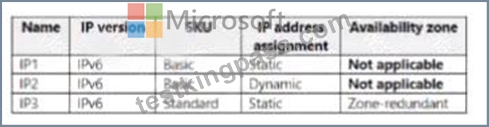
You need to create a public Azure Standard Load Balancer.
Which public IP addresses can you use?
- A. IP3 only
- B. IP2 only
- C. IP1 and IP3 only
- D. IP1, IP2, and IP3
Answer: A
Explanation:
Explanation
A Basic Load Balancer can use the Basic SKU Public IP address's, but a Standard load balancer requires a Standard SKU Public IP address.
Excerpt from link below:
The standard SKU is required if you associate the address to a standard load balancer. For more information about standard load balancers, see Azure load balancer standard SKU.
https://learn.microsoft.com/en-us/azure/virtual-network/ip-services/virtual-network-public-ip-address Excerpt from link below:
Key scenarios that you can accomplish using Azure Standard Load Balancer include:
-Enable support for load-balancing of IPv6.
https://learn.microsoft.com/en-us/azure/load-balancer/load-balancer-overview#why-use-azure-load-balancer
NEW QUESTION # 83
You have an Azure subscription that contains the following resources:
* a virtual network named VNet1
* a replication policy named ReplPolicy1
* a Recovery Services vault named Vault1
* an Azure Storage account named Storage1
You have an Amazon Web Services (AWS) EC2 virtual machine named VM1 that runs Windows Server
2019.
You need to migrate VM1 to VNet1 by using Azure Site Recovery.
Which three actions should you perform in sequence? To answer, move the appropriate actions from the list of actions to the answer area and arrange them in the correct order.
Answer:
Explanation:
Explanation
Step 1: Deploy an EC2 virtual machine as a configuration server
Prepare source include:
* Use an EC2 instance that's running Windows Server 2012 R2 to create a configuration server and register it with your recovery vault.
* Configure the proxy on the EC2 instance VM you're using as the configuration server so that it can access the service URLs.
Step 2: Install Azure Site Recovery Unified Setup.
Download Microsoft Azure Site Recovery Unified Setup. You can download it to your local machine and then copy it to the VM you're using as the configuration server.
Step 3: Enable replication for VM1.
Enable replication for each VM that you want to migrate. When replication is enabled, Site Recovery automatically installs the Mobility service.
References:
https://docs.microsoft.com/en-us/azure/site-recovery/migrate-tutorial-aws-azure
NEW QUESTION # 84
You create a Recovery Services vault backup policy named Policy1 as shown in the following exhibit.

Answer:
Explanation:
NEW QUESTION # 85
You create an Azure web app named WebApp1. WebApp1 has the autoscale settings shown in the following exhibit.

The scale out and scale in rules are configured to have a duration of 10 minutes and a cool down time of five minutes.
Use the drop-down menus to select the answer choice that completes each statement based on the information presented in the graphic.
NOTE: Each correct selection is worth one point.
Answer:
Explanation:
Explanation
Box 1: one instance
Refer to scaling condition provided in the question, August 8, 2018 is outside the schedule of the scale condition 1, and Default instance count is 1.
Box 2: two instances
The default instance count is important because autoscale scales your service to that count when metrics are not available. Therefore, select a default instance count that's safe for your workloads.
The Default instance count of scale condition 1 is 4, and the Scale in rule decreases the count with 1.
So initial instance count before scale in condition met = 4
CPU utilization was at 15% for 60 mins so after first 10 mins ( The scale out and scale in rules are configured to have a duration of 10 minutes )instance count reduces by 1 hence after first 10 mins instance count is 4-1=3 Now cool down period is 5 mins , after first 15 mins instance count is 3 .
After next 15 mins , instance count will be 3-1=2.
After next 15 mins , instance count will be =2 because minimum instance count must be 2 , it can't get reduced beyond 2.
So after 60 mins instance count will be at 2.
Reference:
https://docs.microsoft.com/en-us/azure/azure-monitor/platform/autoscale-best-practices
NEW QUESTION # 86
You recently created a new Azure subscription that contains a user named Admin1.
Admin1 attempts to deploy an Azure Marketplace resource by using an Azure Resource Manager template.
Admin1 deploys the template by using Azure PowerShell
and receives the following error message: "User failed validation to purchase resources. Error message: "Legal terms have not been accepted for this item on this subscription. To accept legal terms, please go to the Azure portal (http://go.microsoft.com/f wlink/?LinkId=534873) and configure programmatic deployment for the Marketplace item or create it there for the first time." You need to ensure that Admin1 can deploy the Marketplace resource successfully.
What should you do?
- A. From Azure PowerShell, run the Set-AzApiManagementSubscription cmdlet
- B. From the Azure portal, register the Microsoft.Marketplace resource provider
- C. From the Azure portal, assign the Billing administrator role to Admin1
- D. From Azure PowerShell, run the Set-AzMarketplaceTerms cmdlet
Answer: D
Explanation:
Explanation
The Set-AzMarketplaceTerms cmdlet saves the terms object for given publisher id(Publisher), offer id(Product) and plan id(Name) tuple.
Reference:
https://docs.microsoft.com/en-us/powershell/module/az.marketplaceordering/set-azmarketplaceterms?view=azps
NEW QUESTION # 87
You need to resolve the licensing issue before you attempt to assign the license again.
What should you do?
- A. From the Directory role blade, modify the directory role.
- B. From the Profile blade, modify the usage location.
- C. From the Groups blade, invite the user accounts to a new group.
Answer: B
Explanation:
Explanation
Scenario: Licensing Issue
1. You attempt to assign a license in Azure to several users and receive the following error message: "Licenses not assigned. License agreement failed for one user."
2. You verify that the Azure subscription has the available licenses.
Solution:
License cannot be assigned to a user without a usage location specified.
Some Microsoft services aren't available in all locations because of local laws and regulations. Before you can assign a license to a user, you must specify the Usage location property for the user. You can specify the location under the User > Profile > Settings section in the Azure portal.
Reference:
https://docs.microsoft.com/en-us/azure/active-directory/users-groups-roles/licensing-groups-resolve-problems
Topic 1, Humongous Insurance
Overview
Existing Environment
Huongous Insurance is an insurance company that has three offices in Miami, Tokoyo, and Bankok. Each has
5000 users.
Active Directory Environment
Humongous Insurance has a single-domain Active Directory forest named humongousinsurance.com. The functional level of the forest is Windows Server 2012.
You recently provisioned an Azure Active Directory (Azure AD) tenant.
Network Infrastructure
Each office has a local data center that contains all the servers for that office. Each office has a dedicated connection to the Internet.
Each office has several link load balancers that provide access to the servers.
Active Directory Issue
Several users in humongousinsurance.com have UPNs that contain special characters.
You suspect that some of the characters are unsupported in Azure AD.
Licensing Issue
You attempt to assign a license in Azure to several users and receive the following error message: "Licenses not assigned. License agreement failed for one user." You verify that the Azure subscription has the available licenses.
Requirements
Planned Changes
Humongous Insurance plans to open a new office in Paris. The Paris office will contain 1,000 users who will be hired during the next 12 months. All the resources used by the Paris office users will be hosted in Azure.
Planned Azure AD Infrastructure
The on-premises Active Directory domain will be synchronized to Azure AD.
All client computers in the Paris office will be joined to an Azure AD domain.
Planned Azure Networking Infrastructure
You plan to create the following networking resources in a resource group named All_Resources:
* Default Azure system routes that will be the only routes used to route traffic
* A virtual network named Paris-VNet that will contain two subnets named Subnet1 and Subnet2
* A virtual network named ClientResources-VNet that will contain one subnet named ClientSubnet
* A virtual network named AllOffices-VNet that will contain two subnets named Subnet3 and Subnet4 You plan to enable peering between Paris-VNet and AllOffices-VNet. You will enable the Use remote gateways setting for the Paris-VNet peerings.
You plan to create a private DNS zone named humongousinsurance.local and set the registration network to the ClientResources-VNet virtual network.
Planned Azure Computer Infrastructure
Each subnet will contain several virtual machines that will run either Windows Server 2012 R2, Windows Server 2016, or Red Hat Linux.
Department Requirements
Humongous Insurance identifies the following requirements for the company's departments:
* Web administrators will deploy Azure web apps for the marketing department. Each web app will be added to a separate resource group. The initial configuration of the web apps will be identical. The web administrators have permission to deploy web apps to resource groups.
* During the testing phase, auditors in the finance department must be able to review all Azure costs from the past week.
Authentication Requirements
Users in the Miami office must use Azure Active Directory Seamless Single Sign-on (Azure AD Seamless SSO) when accessing resources in Azure.
NEW QUESTION # 88
Note: The question is included in a number of questions that depicts the identical set-up. However, every question has a distinctive result. Establish if the solution satisfies the requirements.
Your company has an Azure Active Directory (Azure AD) subscription.
You want to implement an Azure AD conditional access policy.
The policy must be configured to require members of the Global Administrators group to use Multi-Factor Authentication and an Azure AD-joined device when they connect to Azure AD from untrusted locations.
Solution: You access the multi-factor authentication page to alter the user settings.
Does the solution meet the goal?
- A. Yes
- B. No
Answer: B
Explanation:
Explanation
https://docs.microsoft.com/en-us/azure/active-directory/conditional-access/howto-conditional-access-policy-adm
NEW QUESTION # 89
You have an Azure subscription that includes data in following locations: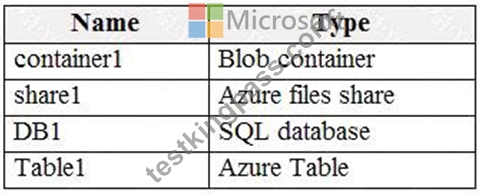
You plan to export data by using Azure import/export job named Export1.
You need to identify the data that can be exported by using Export1.
Which data should you identify?
- A. Share1
- B. container1
- C. DB1
- D. Table1
Answer: A
Explanation:
Explanation
Azure Import/Export service is used to securely import large amounts of data to Azure Blob storage and Azure Files by shipping disk drives to an Azure datacenter.
References:
https://docs.microsoft.com/en-us/azure/storage/common/storage-import-export-service
NEW QUESTION # 90
You are configuring serverless computing in Azure.
You need to receive an email message whenever a resource is created in or deleted from a resource group. Which three actions should you perform in sequence? To answer, move the appropriate actions from the list of actions to the answer area and arrange them in the correct order.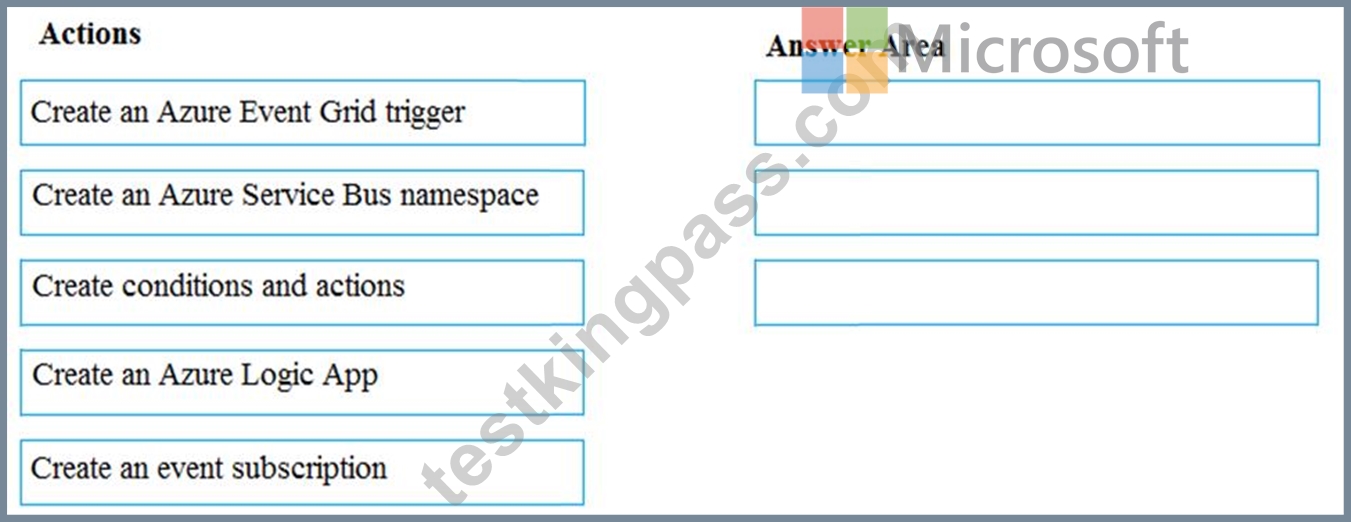
Answer:
Explanation: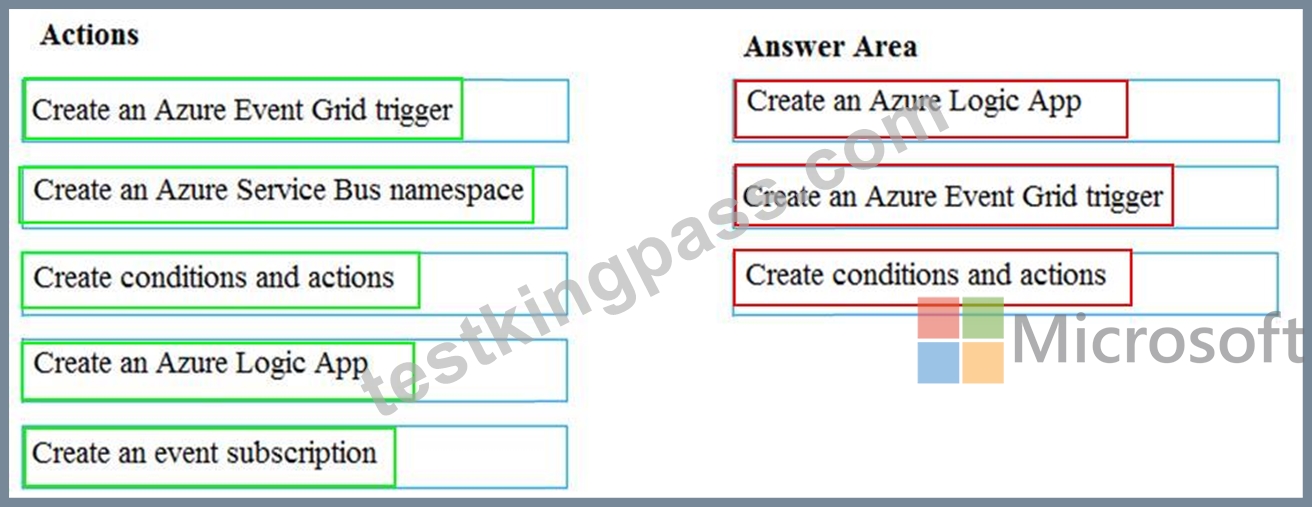
Reference:
https://docs.microsoft.com/en-us/azure/event-grid/monitor-virtual-machine-changes-event-grid-logic-app
https://docs.microsoft.com/en-us/azure/event-grid/monitor-virtual-machine-changes-event-grid-logic-app
NEW QUESTION # 91
You have an Azure virtual machine named VM1 and a Recovery Services vault named Vault1.
You create a backup Policy1 as shown in the exhibit. (Click the Exhibit tab.)
You configure the backup of VM1 to use Policy1 on Thursday, January 1.
You need to identify the number of available recovery points for VM1.
How many recovery points are available on January 8 and on January 15? To answer, select the appropriate options in the answer area.
NOTE: Each correct selection is worth one point.
Answer:
Explanation:
NEW QUESTION # 92
You have an Azure subscription named Subscription1.
You create an Azure Storage account named contosostorage, and then you create a file share named data.
Which UNC path should you include in a script that references files from the data file share? To answer, drag the appropriate values to the correct targets. Each value may be used once, more than once, or not at all. You may need to drag the split bar between panes or scroll to view content.
NOTE: Each correct selection is worth one point.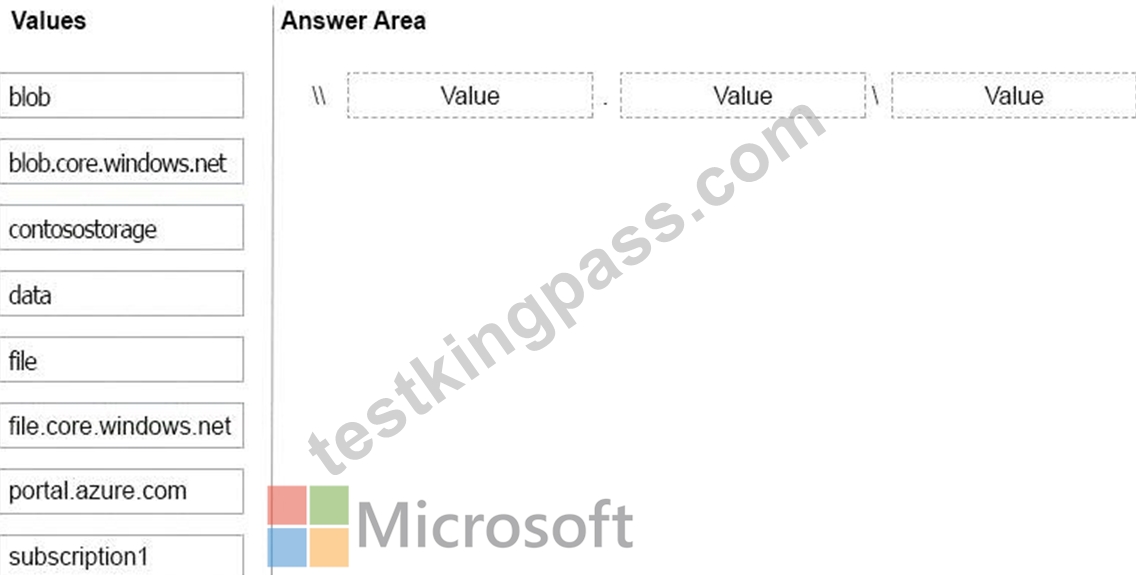
Answer:
Explanation: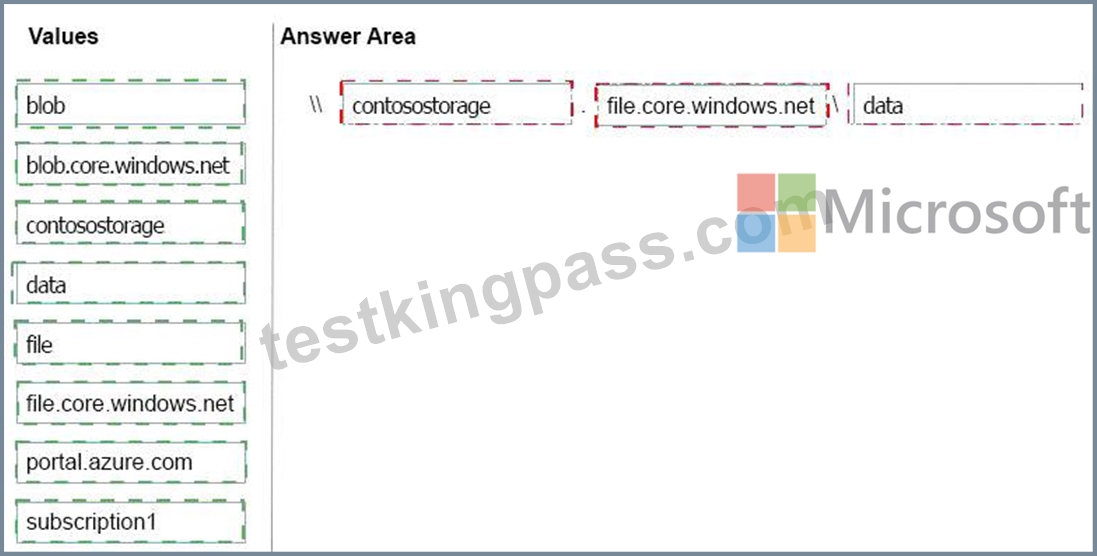
Explanation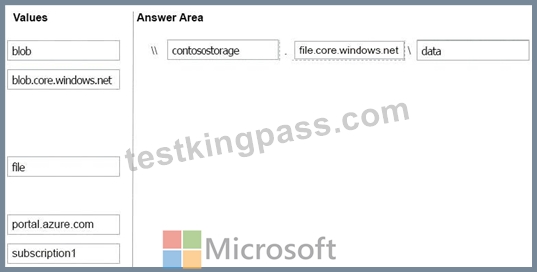
Box 1: contosostorage
The name of account
Box 2: file.core.windows.net
Box 3: data
The name of the file share is data.
Example:
References: https://docs.microsoft.com/en-us/azure/storage/files/storage-how-to-use-files-windows
NEW QUESTION # 93
You onboard 10 Azure virtual machines to Azure Automation State Configuration.
You need to use Azure Automation State Configuration to manage the ongoing consistency of the virtual machine configurations.
Which three actions should you perform in sequence? To answer, move the appropriate actions from the list of actions to the answer area and arrange them in the correct order.
NOTE: More than one order of answer choices is correct. You will receive credit for any of the correct orders you select.
Answer:
Explanation:
1 - Upload a configuration to Azure Automation State Configuration.
2 - Compile a configuration into a node configuration.
3 - Assign the node configuration
4 - Check the compliance status of the node
Reference:
https://docs.microsoft.com/en-us/azure/automation/automation-dsc-getting-started
NEW QUESTION # 94
You have an Azure subscription
You need to use an Azure Resource Manager (ARM) template to create a virtual machine that will have multiple data disks.
How should you complete the template? To answer select the appropriate options in the answer area NOTE: Each correct selection n worth one point.
Answer:
Explanation: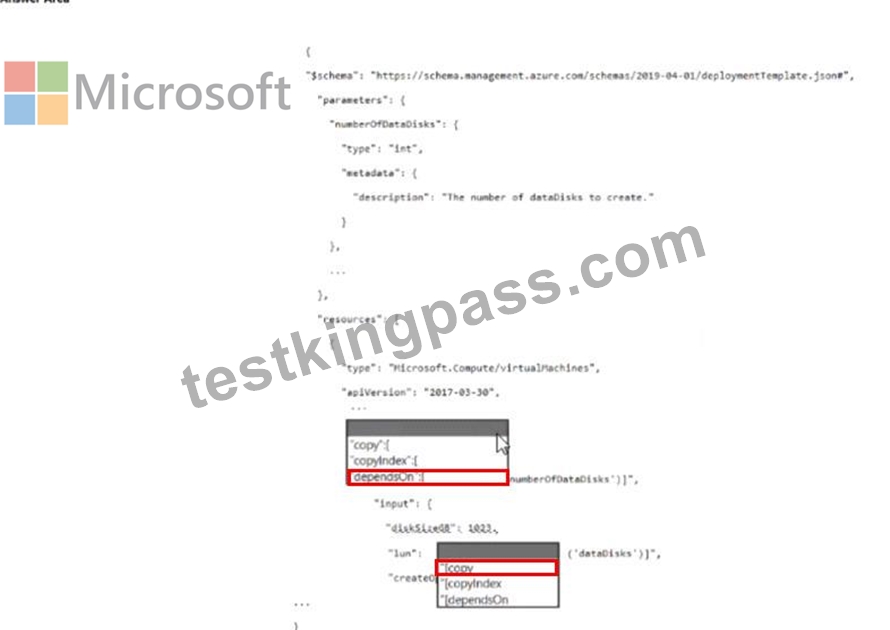
NEW QUESTION # 95
You have an Azure subscription named Subscription1. Subscription1 contains a virtual machine named VM1.
You install and configure a web server and a DNS server on VM1.
VM1 has the effective network security rules shown in the following exhibit.
Use the drop-down menus to select the answer choice that completes each statement based on the information presented in the graphic.
NOTE: Each correct selection is worth one point.
Answer:
Explanation:
Box 1:
Rule2 blocks ports 50-60, which includes port 53, the DNS port. Internet users can reach the Web server, since it uses port 80.
Box 2:
If Rule2 is removed internet users can reach the DNS server as well.
Note: Rules are processed in priority order, with lower numbers processed before higher numbers, because lower numbers have higher priority. Once traffic matches a rule, processing stops. As a result, any rules that exist with lower priorities (higher numbers) that have the same attributes as rules with higher priorities are not processed.
References:
https://docs.microsoft.com/en-us/azure/virtual-network/security-overview
NEW QUESTION # 96
You create an Azure VM named VM1 that runs Windows Server 2019.
VM1 is configured as shown in the exhibit. (Click the Exhibit button.)
You need to enable Desired State Configuration for VM1.
What should you do first?
- A. Start VM1.
- B. Connect to VM1.
- C. Configure a DNS name for VM1.
- D. Capture a snapshot of VM1.
Answer: A
Explanation:
Status is Stopped (Deallocated).
The DSC extension for Windows requires that the target virtual machine is able to communicate with Azure.
The VM needs to be started.
References:
https://docs.microsoft.com/en-us/azure/virtual-machines/extensions/dsc-windows
NEW QUESTION # 97
You have an Azure subscription named Subscription1. Subscription1 contains the resources in the following table.
In Azure, you create a private DNS zone named adatum.com. You set the registration virtual network to VNet2. The adatum.com zone is configured as shown in the following exhibit.
For each of the following statements, select Yes if the statement is true. Otherwise, select No.
NOTE: Each correct selection is worth one point.
Answer:
Explanation:
NEW QUESTION # 98
You have an Azure virtual machine that runs Windows Server 2019 and has the following configurations:
* Name: VM1
* Location: West US
* Connected to: VNET1
* Private IP address: 10.1.0.4
* Public IP address: 52.186.85.63
* DNS suffix in Windows Server: Adatum.com
You create the Azure DNS zones shown in the following table.
You need to identify which DNS zones you can link to VNET1 and the DNS zones to which VM1 can automatically register.
Which zones should you identify? To answer, select the appropriate options in the answer area.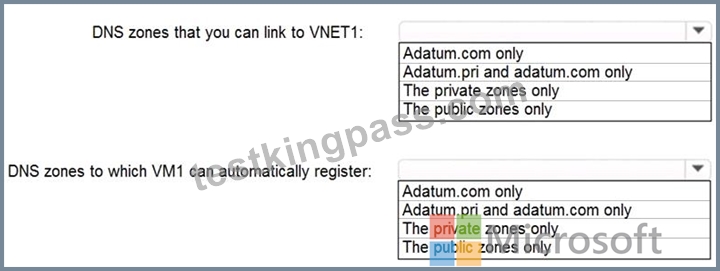
Answer:
Explanation:
Reference:
https://docs.microsoft.com/en-us/azure/dns/private-dns-overview
NEW QUESTION # 99
Your company has three offices. The offices are located in Miami, Los Angeles, and New York. Each office contains a datacenter.
You have an Azure subscription that contains resources in the East US and West US Azure regions. Each region contains a virtual network. The virtual networks are peered.
You need to connect the datacenters to the subscription. The solution must minimize network latency between the datacenters.
What should you create?
- A. three virtual WANs and one virtual hub
- B. three On-premises data gateways and one Azure Application Gateway
- C. three Azure Application Gateways and one On-premises data gateway
- D. three virtual hubs and one virtual WAN
Answer: A
Explanation:
Explanation
Azure Virtual WAN is a networking service that brings many networking, security, and routing functionalities together to provide a single operational interface.
The Virtual WAN architecture is a hub and spoke architecture with scale and performance built in for branches (VPN/SD-WAN devices), users (Azure VPN/OpenVPN/IKEv2 clients), ExpressRoute circuits, and virtual networks.
Azure regions serve as hubs that you can choose to connect to. All hubs are connected in full mesh in a Standard Virtual WAN making it easy for the user to use the Microsoft backbone for any-to-any (any spoke) connectivity.
Virtual WAN offers the following advantages:
Integrated connectivity solutions in hub and spoke: Automate site-to-site configuration and connectivity between on-premises sites and an Azure hub.
Automated spoke setup and configuration: Connect your virtual networks and workloads to the Azure hub seamlessly.
Intuitive troubleshooting: You can see the end-to-end flow within Azure, and then use this information to take required actions.
Reference:
https://docs.microsoft.com/en-us/azure/virtual-wan/virtual-wan-about
NEW QUESTION # 100
You need to define a custom domain name for Azure AD to support the planned infrastructure.
Which domain name should you use?
- A. Join the client computers in the Miami office to Azure AD.
- B. Install Azure AD Connect on a server in the Miami office and enable Pass-through Authentication
- C. Allow inbound TCP port 8080 to the domain controllers in the Miami office.
- D. Add http://autologon.microsoftazuread-sso.com to the intranet zone of each client computer in the Miami office.
- E. Install the Active Directory Federation Services (AD FS) role on a domain controller in the Miami office.
Answer: B,D
Explanation:
Every Azure AD directory comes with an initial domain name in the form of domainname.onmicrosoft.com. The initial domain name cannot be changed or deleted, but you can add your corporate domain name to Azure AD as well. For example, your organization probably has other domain names used to do business and users who sign in using your corporate domain name. Adding custom domain names to Azure AD allows you to assign user names in the directory that are familiar to your users, such as '[email protected].' instead of 'alice@domain name.onmicrosoft.com'.
Scenario:
Network Infrastructure: Each office has a local data center that contains all the servers for that office. Each office has a dedicated connection to the Internet.
Humongous Insurance has a single-domain Active Directory forest named humongousinsurance.com Planned Azure AD Infrastructure: The on-premises Active Directory domain will be synchronized to Azure AD.
References:
https://docs.microsoft.com/en-us/azure/active-directory/fundamentals/add-custom-domain
NEW QUESTION # 101
You need to configure the Device settings to meet the technical requirements and the user requirements.
Which two settings should you modify? To answer, select the appropriate settings in the answer area.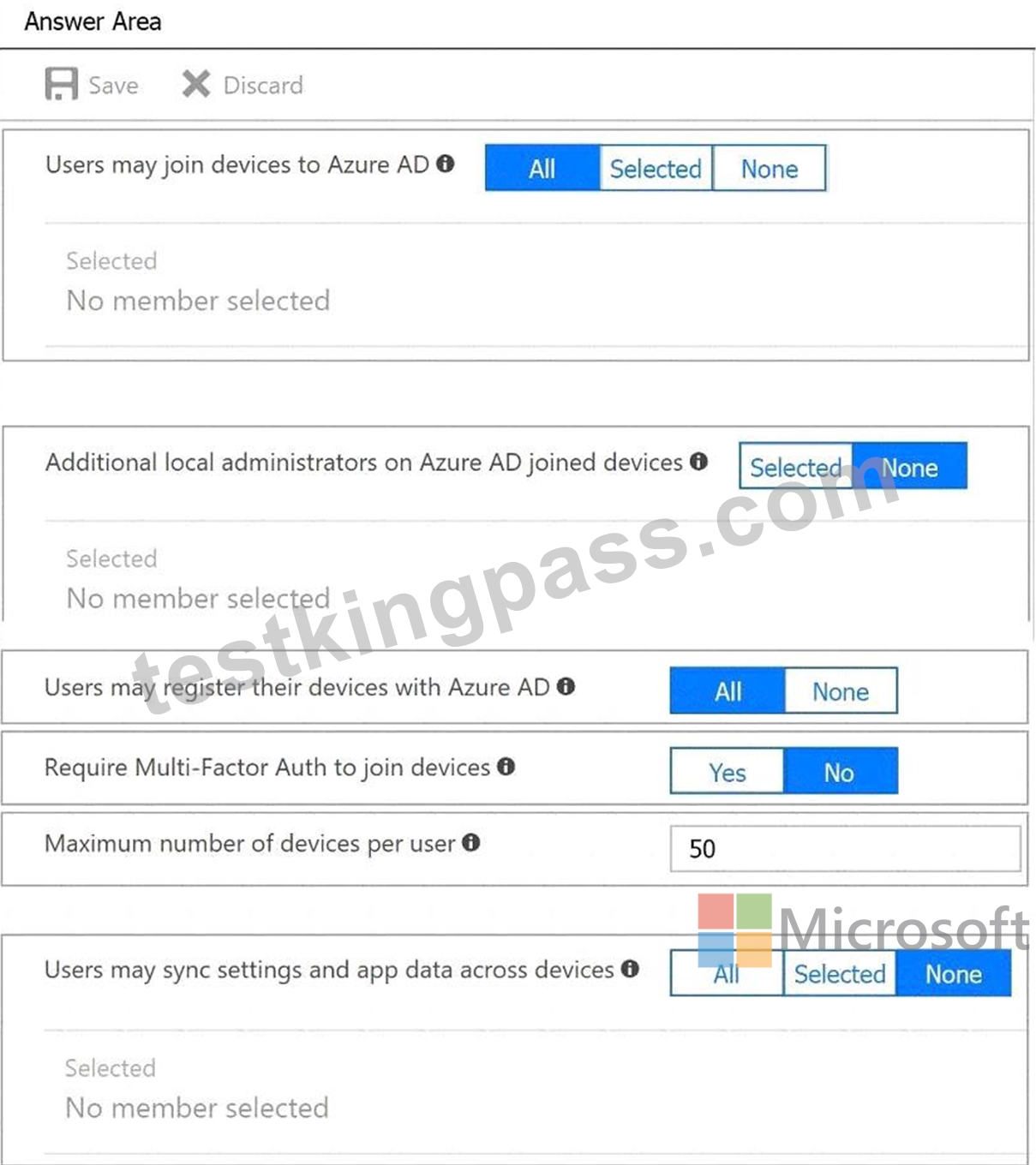
Answer:
Explanation:
Explanation

Box 1: Selected
Only selected users should be able to join devices
Box 2: Yes
Require Multi-Factor Auth to join devices.
From scenario:
* Ensure that only users who are part of a group named Pilot can join devices to Azure AD
* Ensure that when users join devices to Azure Active Directory (Azure AD), the users use a mobile phone to verify their identity.
NEW QUESTION # 102
You have an Azure virtual machine that runs Windows Server 2019 and has the following configurations:
Name: VM1
Location: West US
Connected to: VNET1
Private IP address: 10.1.0.4
Public IP addresses: 52.186.85.63
DNS suffix in Windows Server: Adatum.com
You create the Azure DNS zones shown in the following table.
You need to identify which DNS zones you can link to VNET1 and the DNS zones to which VM1 can automatically register.
Which zones should you identify? To answer, select the appropriate options in the answer area.
NOTE: Each correct selection is worth one point.
Answer:
Explanation:
Reference:
https://docs.microsoft.com/en-us/azure/dns/private-dns-overview
NEW QUESTION # 103
......
Latest 100% Passing Guarantee - Brilliant AZ-104 Exam Questions PDF: https://passguide.testkingpass.com/AZ-104-testking-dumps.html